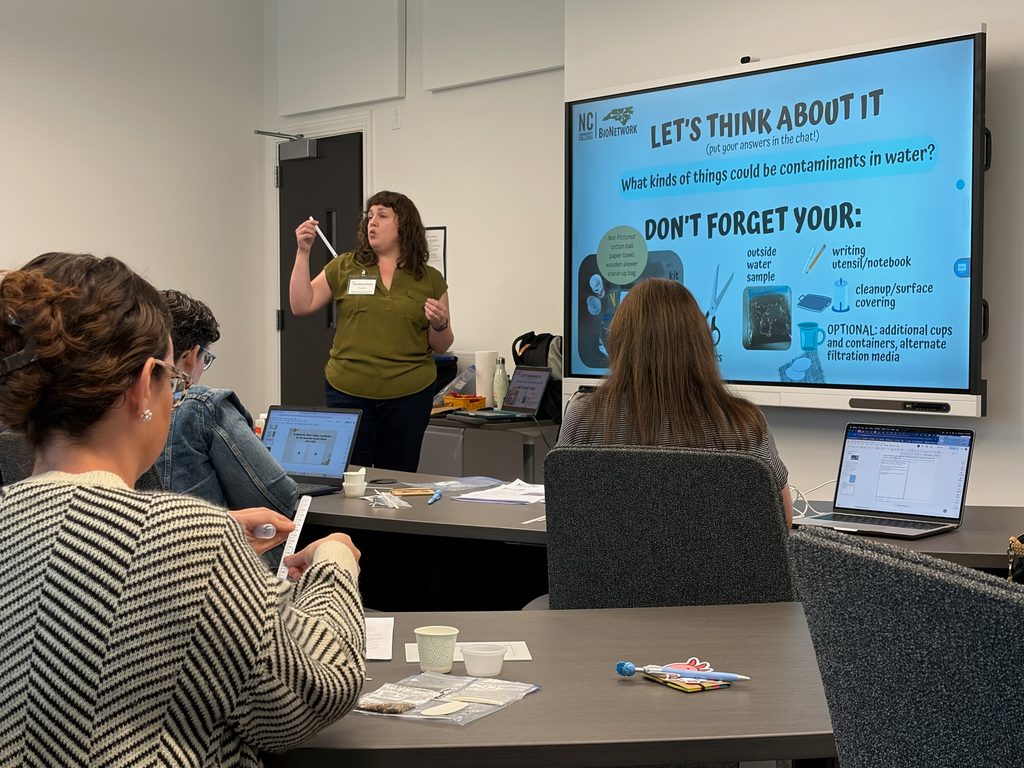
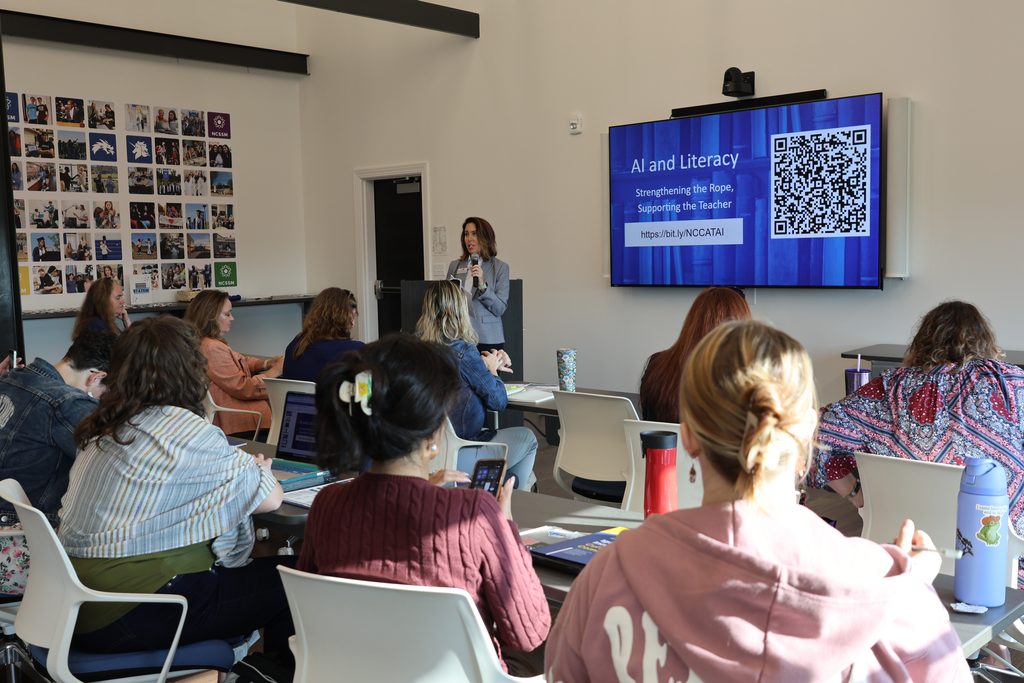
Professional development opportunities such as Teaching in the Times of Transformation allow educators to feel like students again. (photo: Rob Caldwell)
news
Educators from near and far find transformative value in NCSSM professional development
Educators from near and far find transformative value…
Print
Share
The teaching and learning landscape is going through what could arguably be one of the most transformative periods in the history of public education. AI’s influence on the classroom garners the most attention, but its rapid spread into nearly all facets of education has brought with it an almost unprecedented and wide-ranging collection of challenges that, just a handful of years ago, could not have been anticipated by educators.
This is what Morgan Pittman, NCSSM-Morganton’s Instructional Designer and Curriculum Specialist, was thinking of when she had the idea of creating a new professional development conference at NCSSM-Morganton called Teaching in the Times of Transformation.
“There are a lot of things going on,” Pittman says. “Pedagogy is shifting within the classroom, teachers are shifting from lecture-based instruction into more innovative instruction. Student resilience and mental health are changing, too. There’s just a lot of transformation happening and we thought, let’s not make it [specifically] an AI conference or a STEM conference, but make it a conference that allowed our presenters to focus on what they see transforming in the classroom.”
Participants in the Teaching in the Times of Transformation mini-conference got a chance to do hands-on activities as well as network with fellow educators from throughout North Carolina. (photo: Rob Caldwell)
Designed to help middle and high school teachers from throughout North Carolina gain new insight into meeting some of these challenges, the day-long mini-conference brought together 50 educators from every region of the state. A keynote presentation by Kendra Cameron-Jarvis, the Senior Literacy Specialist at NCCAT, began the day, followed by a selection of nine hour-long sessions participants could choose from. Sessions covered topics such as using generative AI to more efficiently and effectively meet diverse student needs through differentiated instruction and implementing coaching tools to increase student engagement and make learning more enjoyable. Among the presenters at the conference were Tess Nielsen, Instructor of Choral Music and Drama at NCSSM-Morganton, and Michelle Ellwanger, a member of NCSSM’s Board of Trustees.
The mini-conference marked the first time that Sara Mofford, a media coordinator at Jacobs Fork Middle School in Newton, had participated in NCSSM professional development. She said the conference was “a beautiful opportunity” to familiarize herself with some of the most recent developments in the education field and hear how folks in roles different from hers are addressing issues that reach across disciplines. The event provided her with concrete ideas to take back to her school as well as an intangible sense that she was in the field she was meant to be in.
“[The conference] kind of refocused what we got into education for, which is for the kids,” she says. “It’s really nice to get self-confirmation of why we’re here.”
AI’s influence on the classroom led to a greater discussion about current challenges in the field of education. (photo: Emily Cunard)
Holly Lowrance came to the conference from Bandys High School in Catawba, where she, too, is a media coordinator. Conferences like Teaching in the Times of Transformation, she says, allows educators to step outside their day-to-day network and hear from others throughout the state who have unique perspectives and skills.
“Coming to a workshop like this is valuable. We met a teacher here from Hickory Career and Arts Magnet High School who we’re literally in the same county with but never are connected to, and we got to speak and connect with her here, and she was able to share resources and stuff that we can take back and share with our teachers as well.”
Such collaborations are what conference organizers had in mind as they designed the day’s programming, says Joyce Ventimiglia, NCSSM’s Durham-based Digital Media and Instructional Manager and one of the many NCSSM team members who worked with Pittman to arrange the event.
“When we were doing our planning, we had the thought that a small, intimate, in-person conference would work really well on the Morganton campus,” she says.
“Our teachers here in Western North Carolina do not have easy access to professional development like they do in Durham or Charlotte or Greensboro,” says Pittman. “If teachers out here want to go to an educational conference, they have to travel. So, to be a hub for that is a vision that I would like to see for us.”
The conference, which Pittman says the school hopes to offer annually in Morganton, does more than offer local access. It also moves NCSSM-Morganton another step forward in its development as a fully-fledged resource for students and educators throughout the state. And while NCSSM as a whole already offers a wide range of professional learning opportunities serving hundreds of educators through its outreach and academic programs, the mini-conference further develops NCSSM’s capacity to fulfill its mandate to enhance public education throughout North Carolina.
The field trip to NCSSM-Morganton was a first for Mofford, but not for Lowrance, who had visited previously for a Battle of the Books high school event. Odds are good, however, that when future opportunities arise, they’ll both have the same reaction that Lowrance had when she received the email promoting Teaching in the Times of Transformation.
“Whenever I got that,” she says, “I just remember thinking, ‘We have to go.’”