
Manny Price ’26 was one of the student scientists in the “Art of a Scientist” exhibit at NCSSM. (photo: Brian Faircloth)

One of NCSSM’s defining academic characteristics is its commitment to providing students with a cross-curricular experience that increases their understanding of how the world’s systems – scientific, mathematical, and creative – all contribute to each other in myriad ways.
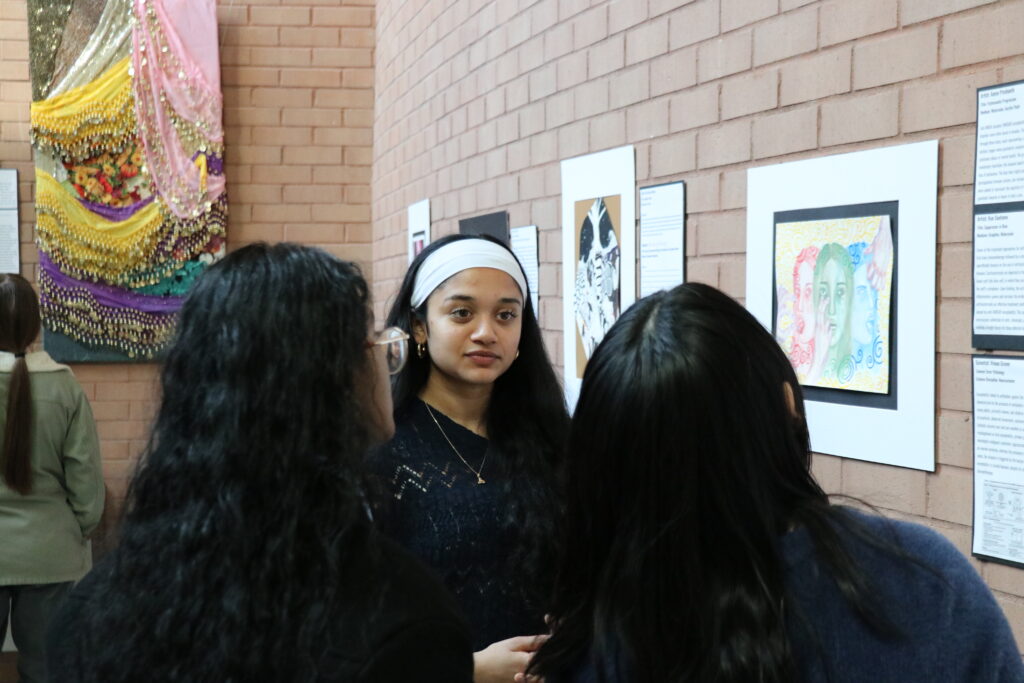
“Art of a Scientist,” an annual exhibit which hung for three weeks in the lobby of NCSSM-Durham’s John Friedrick Educational Technology Complex, was an illustrative manifestation of the synergy between art and science. Displayed throughout the ETC’s lobby were a number of paired collaborations that saw student artists creating paintings, drawings, mixed media, and written pieces inspired by scientific research carried out by student researchers. The science originated from multiple disciplines and included research in fields such as genetics, immunology, neuroscience, engineering, environmental science, and computational science. Once it has completed its run at NCSSM, a curated portion of the exhibit will move across town to Durham’s Museum of Life and Science.
Reagan Greene, a junior who came to NCSSM from Greene Central High School in Snow Hill, and senior Muhilan Krishnan, who came to NCSSM from Olympic High School in Charlotte, were one of the pairs whose work was displayed in the lobby. To inform her artistic efforts, Reagan dove deep into Muhilan’s work on the energy-absorbent properties of metamaterials and conducted her own research into the physics supporting it. What resulted was a pencil and marker drawing of geometric shapes and patterns that was very much unlike any work she had created in the past.
“Muhilan’s research had very precise measurements and precise theorems and all that, and I think me trying to show that in a way of lines on paper [resulted in] being precise,” Reagan said. “I drew almost the entire thing with a ruler.”
Muhilan had never seen his research interpreted in such a way, and it enhanced both his and the viewing public’s understanding of his work.
“I come from a research program where everybody kind of looks through the research that I’d done through a scientific lens,” he says, “but Reagan really conveyed a lot of the core aspects of my research through the artwork that she created and it showed me a lot of the connections that I hadn’t seen previously among the different samples that I tested. That was really helpful, especially as I talked to people about the research during the exhibit. They were able to kind of grasp what the project was doing just by seeing that image and my explanation behind the science.”
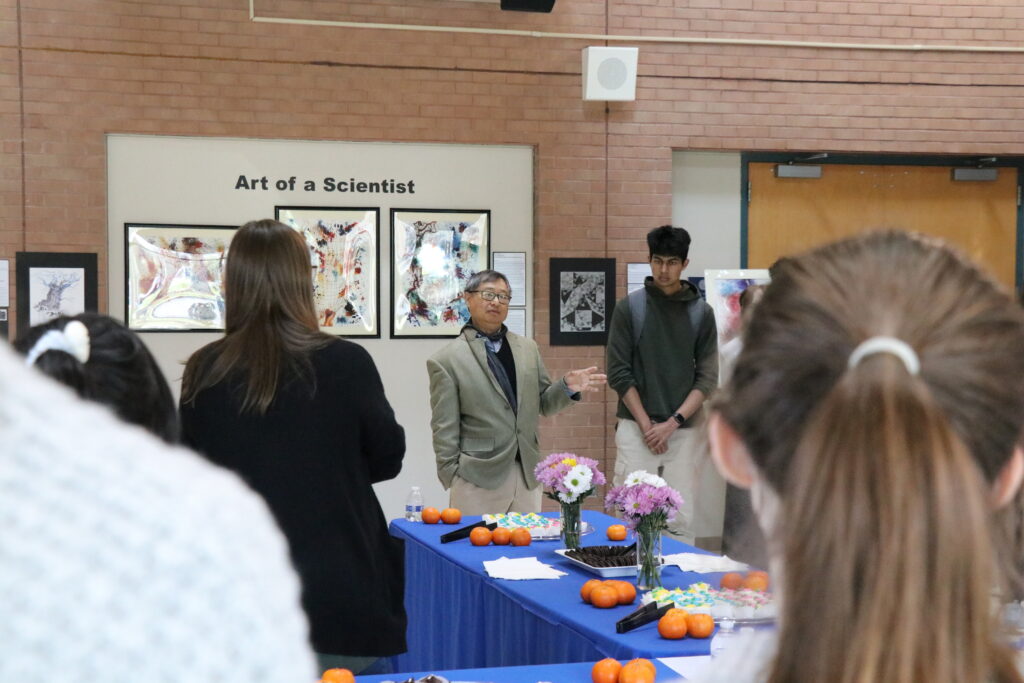
Though similar exhibits have hung each year in the lobby since the pandemic, this year was a highwater mark regarding the number of participants, says Amy Sheck, NCSSM’s Dean of Science, who worked with Carrie Alter, the visual arts instructor and curator on the Durham campus, to organize the event. “We doubled the size of the exhibit this year compared to last and student participation was completely voluntary.”
Art and science have operated as partners for centuries, says Alter. “During the Renaissance period, art and science were like one. There was this bond between the arts and sciences that helped innovation during that time. I feel like we’re coming back to joining forces now.”
For Sheck, the event emphasized a vital aspect of scientific research: communicating the results.
“Science communication can take many forms,” Sheck says. “Scientists are always looking for different modes to communicate their work, and this is another way to do that.”
Having travelled all the way from Boston to be the guest speaker at the exhibition’s opening was Dan Jay, Professor Emeritus and Dean Emeritus in the Graduate School of Biomedical Sciences at Tufts University, as well as an Adjunct Professor of Drawing and Painting at the School of the Museum of Fine Arts in Boston. For 40 years Jay has worked as a scientist and an artist whose work in both fields has informed the other.
“It was inspiring for me to talk with the students at NCSSM, and feel their passion, feel how well that they worked together,” he said of his visit to NCSSM. “Art has always been a way to open minds and to make one aware of awe and wonder, and the ability of science to also fill us with awe and wonder can only benefit when artists work with scientists and talk together for outreach and communication.”
The value of blending the disciplines was reflected in Reagan’s experience. “Having my own portrayal of Muhilan’s research definitely helped me understand what he was talking about a lot more and kind of understand where his mind was throughout the whole process, and that was fun. When humanities students mix with science students and try to understand each other in a different way, that is a fun connection to make, definitely.”


