
Caroline Seibeck, Maggie Neller, and Stephenanh Thomas (left to right) – all seniors at NCSSM-Morganton – have spent part of their summer working at an archeological dig site. (photo: Brian Faircloth)

Tucked between a Christmas tree farm and a creek running through a tangled line of native growth a few miles north of NCSSM-Morganton is a wild grass field called the Berry Site. Named in recognition of the family that owns the land, the field seems unremarkable at a distant glance. But when you get closer and see the sharply defined excavations cut into the grey-brown earth, you begin to realize that this place is special.
For at least 500 years, this field has held secrets of past inhabitants. Some of the folks who lived on this land generations ago were native to this place. They called their community Joara. The others who lived here, just yards away, were strangers in a strange land who came from Spain to claim parts of a continent new to them. They called their settlement Cuenca, and they built a fortification called Fort San Juan. For years the two groups lived as immediate neighbors in this field until relations eventually deteriorated and the fort was destroyed.
For well over a century now, the site has yielded remnants of those previous generations of inhabitants. So well known was the site that the Smithsonian Institution visited it in the 1880s and formally recorded it as an archaeological site.
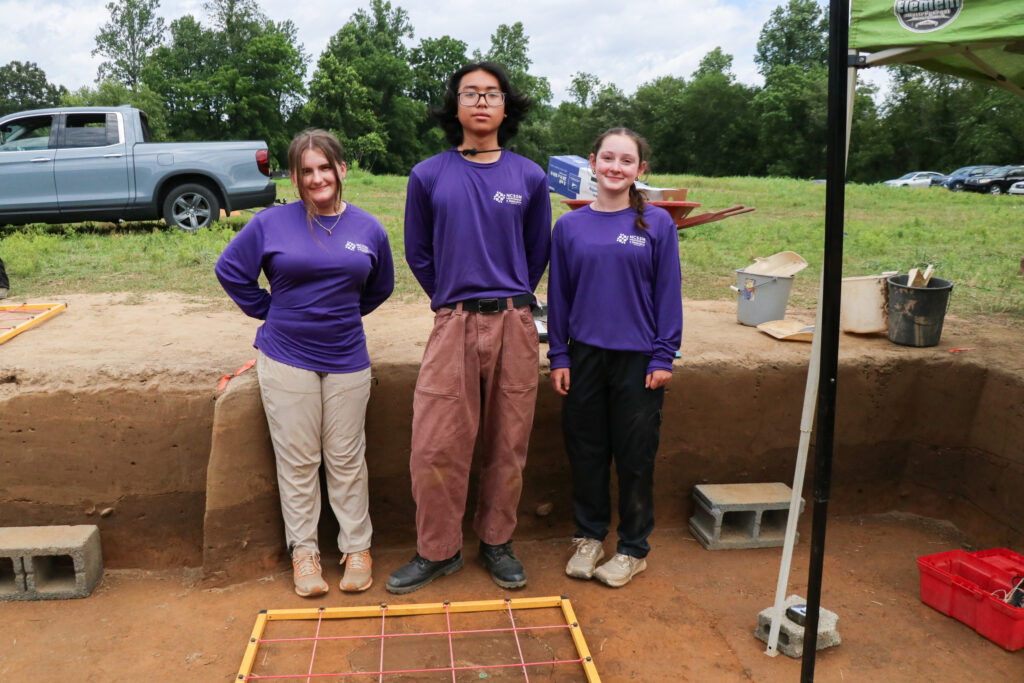
Maggie Neller, Caroline Seibeck, and Stephenanh Thomas – all seniors at NCSSM-Morganton – are among the most recent people to walk upon this historic ground. They’re part of a larger team of archaeologists and university students who have been focused this summer on revealing another part of this land’s history by uncovering the secrets of the Joara community.
By the end of their three weeks working on the excavation, the students will have spent time working under canopies on-site where they moved soil and collected artifacts, and in a lab back in town where they examined, evaluated, and cataloged finds such as tools, pottery, and projectile points.
On this particular day, the trio are examining an unusually colored section of soil on the floor of the excavation, about 30 inches or so below ground level. They lay a gridded frame of metal and string across the patch of ground, then draw the shape of the discolored soil as closely to scale as they can. Maggie, who came to NCSSM from Pinecrest High School in Pinehurst, takes a turn at creating the drawing for a couple of minutes before turning it over to one of her classmates.
“It just looks like dirt, doesn’t it?” she says as she steps aside, but she explains that it’s likely more than that. She points to an opposite corner of the excavation where some university students are gathered around a similar spot. The remains of burned corn cobs were recently uncovered there. The darker soil that Maggie, Caroline, and Stephenanh are examing may be the same thing: a burn pit.
What will they find in this spot? They won’t know until they begin digging, which they will turn to as soon as the scaled-drawing of the area is complete.
Here by choice
The work NCSSM students are doing at Joara is part of the school’s Summer Mentorship program, which offers multiple opportunities over the summer for NCSSM students to supplement their academic year courses with additional experiences that further their development as students, investigators, and citizens of the state.
What makes Mentorship unique is that students like Maggie, Caroline, and Stephenanh chose to spend part of their summer vacation bolstering their knowledge of the world around them.
“Mentorship is a choice program,” says Christiane Burkins, NCSSM-Morganton’s Director of Mentorship and Research. “Students are not required as part of their graduation requirements to participate in the program. They can elect to apply for Mentorship or not. But the students here are choosing to do something valuable that is above and beyond what is being asked of them curricularly. They’re making that choice to pursue that margin of excellence.”
That pursuit of excellence wouldn’t be possible without the multitude of off-campus and community partners that collaborate with NCSSM during the summer. Burkins is quick to express gratitude for their continued faith in NCSSM’s students and the school as a whole.
“Joara was one of our first partners when this Morganton campus opened,” she says. “We asked them to take a chance on our students and us, and they said, ‘Wow, these students can do some really impressive things and we want to continue that partnership.’ That’s fortunate for us. Our faculty members have a wealth of knowledge, but there are resources outside of what NCSSM provides that these partners are providing. There’s no way we could create our own 16th century archaeological dig site and then give our students that opportunity.”
Chris Rodning is a professor of anthropology at Tulane University in New Orleans, and a co-director of the project. He is also one of the lead mentors at the Berry Site and has worked with NCSSM students at Joara for several years now. As in the past, this current group of Science and Mathers have been a pleasure to work with, he says.
“They are talented students, they are hard workers, they are diligent, they are conscientious, they are friendly and kind, and they are respectful of us as project co-directors and our supervisors, of each other, and of themselves, and of the many other students who are part of our crew.”
As important as the archaeological work is, Rodning adds that being part of the larger team at the site has additional benefits for NCSSM’s students as well.
“I’d like to think that for the archaeology interns, not only are they getting a really interesting exposure to doing archaeology and thinking about how we go about studying what life was like in the past, but they get to meet students from many different colleges and universities.”
Dirty hands and dusty clothes
A lot of time is spent kneeling or sitting on the ground at a dig site. With the drawing of the potential burn site now complete, Maggie, Caroline and Stepenanh situate themselves around the darkened spot as comfortably as they can, kneeling down or laying on one’s side to find the most comfortable position to work. Each student has a small trowel in hand, and they begin excavating the spot. It’s a very tactile activity, both laborious and precise. Each scoop of dirt may yield an artifact last touched by human hands centuries upon centuries ago.
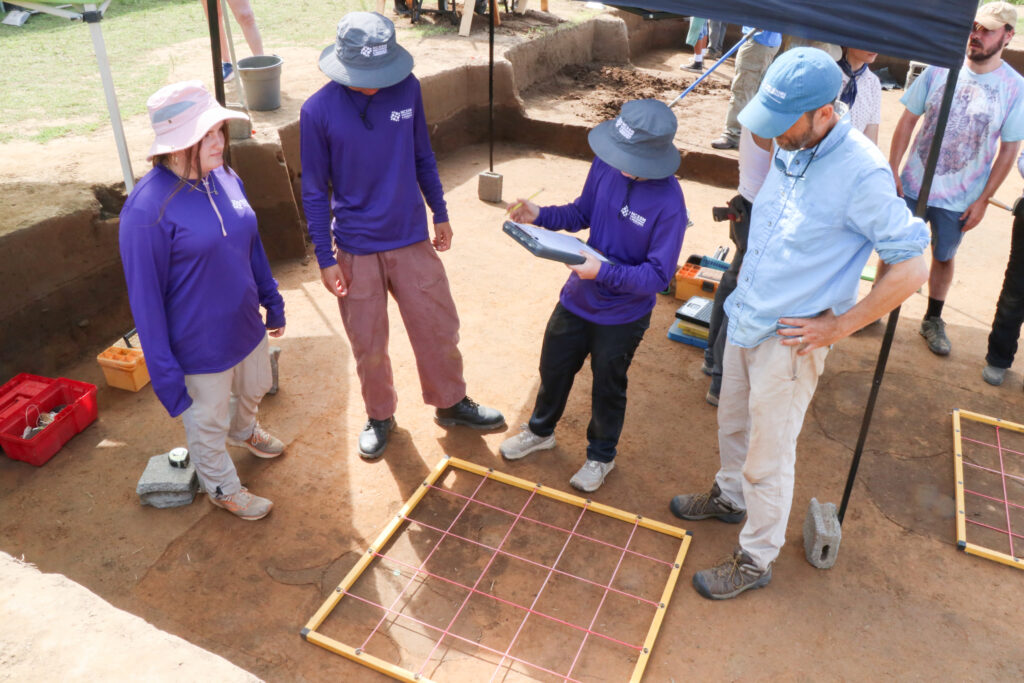
The precision of the dig was a surprise to Caroline, who came to NCSSM from the Franklin School of Innovation in Asheville.
“I was expecting, like, a crazy old dirty, dig site basically, but it’s very cleaned up looking,” she says as she carefully skims a thin layer of soil into her trowel and deposits it into a small bucket to be carried to the sifting table.
Aside from the orderly way the site looks, she was also unsure of exactly what they would discover. She’d never done archaeology work before.
“People say you find a lot of dinosaur fossils [when you dig] so I was assuming I would see a whole bunch of fossilized things, but I definitely realized there’s a lot more stuff, like pottery, that has so much meaning behind it.”
Stephenanh, who calls Mt. Gilead home and came to NCSSM from Montgomery County Early College, sits next to Caroline. He’s skimming soil, too, and admits that he was also unaware of how many artifacts the site would yield. Of the several pieces he’s discovered in the preceding days at the site, the most intriguing has been the mouthpiece end of a smoking pipe, and two gaming pieces.
“I got really excited about the pieces I found, but it hits harder in retrospect,” he says. “When we first found them, obviously we were excited, but the next day when we actually thought about how people used them and made them, it was just awesome.”
To many, the arrowhead remains perhaps the most iconic artifact associated with early Native American civilizations. There have certainly been plenty of those found at Joara. But Maggie found one that was especially intriguing. Still attached to it was a glue made from local natural sources that Native people used to help attach projectiles to arrows and spears. That unexpected find resonated with her and made the moment real.
“This wasn’t just something in a museum,” she says. “This arrowhead was attached to something. They used this.”
Such understanding is what Mentorship is designed in part to facilitate, says Burkins, the Director of Mentorship and Research. “What students get out of Mentorship is largely contingent upon them,” she says. “They’re going to learn a lot of hard and soft skills, and they’re going to have some very unique and unexpected surprises along the way that they never anticipated. And that is fantastic.”
Whether sifting through history one spadeful of soil at a time or peering through a microscope in a lab, the experiences students get through Summer Mentorship expand their world in ways classroom lectures never can. Such opportunities, and the partners such as the Exploring Joara Foundation who help facilitate them, are a large part of why NCSSM remains such an important part of the state’s efforts to enhance public education in North Carolina.
But the discoveries at Joara will have to wait for at least another day. Drops of rain begin to fall, with more to come from dark clouds approaching in the distance. The rain is as important now as it was to the civilizations that lived here before, but for the moment, tools need to be gathered and tent canopies collapsed. For five hundred years or more, many of the secrets buried at Joara have endured. One more day will just add to the mystery.


