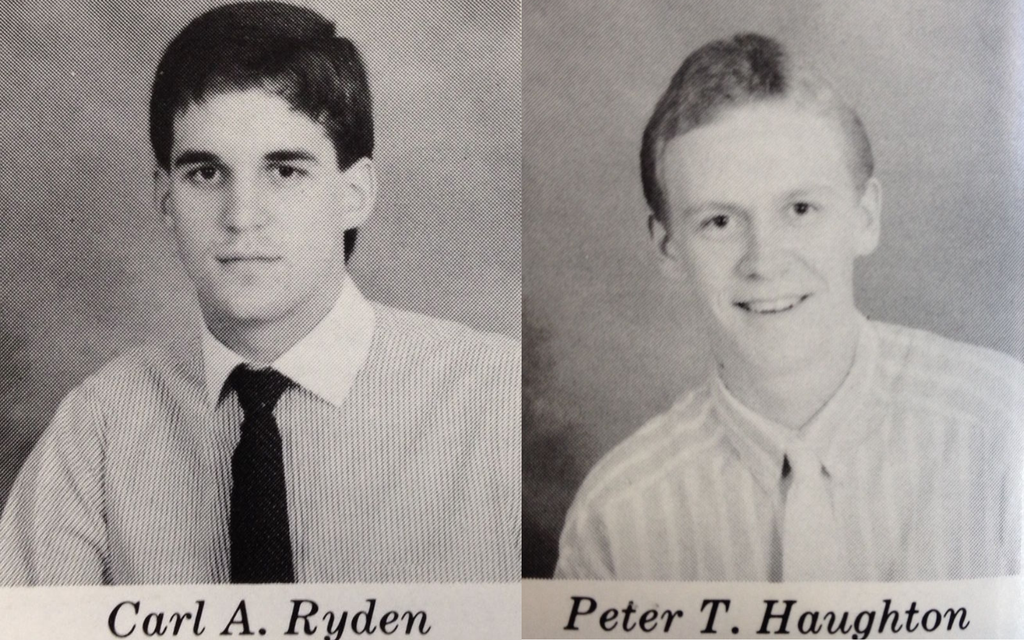
The friendship Carl Ryden '89 had with fellow classmate Peter Haughton led to Ryden spearheading the creation of the Peter T. Haughton Fabrication Laboratory on the NCSSM-Durham campus, where Ryden delivered the keynote address at the laboratory's dedication ceremony. (photo: submitted)
He’s the CEO of a booming tech start-up and a dad to two young kids. Yet Carl Ryden ’89 donates countless hours of his time to NCSSM.
This school rescued him, he says. It also introduced him to an inspirational friend and changed the course of his life.
Carl Ryden ’89 cofounded and runs the kind of thriving business you picture when you think of a tech start-up. The offices of PrecisionLender in Cary are airy and modern. The employees — in a mix of dress shirts and T-shirts — are young, bright, and driven. And business is booming. Ryden grows animated when he outlines his company’s prospects for mushrooming growth. PrecisionLender provides cloud-based solutions that help banks better manage pricing, profitability, relationships, and building portfolios.
It’s a casual Friday in late summer and Ryden is getting ready for the all-staff lunch. In his T-shirt and shorts, with curly dark hair and an earnest face, it’s not hard to imagine the squarely built CEO as the confident teenager who entered North Carolina School of Science and Mathematics in the mid-1980s. It’s a story Ryden likes to tell, starting with how in his admissions interview, he brazenly told biology instructor Ross Baker, “this school was built for kids like me” — smart kids who are bored in their current schools. When he was placed into Introduction to College Math, the lowest rung on the ladder of math classes, he walked up to Lawrence Gould, his instructor, on the first day of class and told him there’d been a mistake.
But all that confidence was about to be tested.
“Dr. Gould told me, ‘You’re probably right. Let’s just see how you do on the first test,’” Ryden remembers. His test came back with a 65 on it. He’d never received such a low mark on anything, especially math. He remembers “literally thrashing about” in the pavilion outside of “New Dorm,” Hunt residence hall. His confidence was shattered. He wondered if he even belonged at this new school.
Then up walked Pete Haughton ‘89, a classmate Ryden had known for about a week. Haughton was taking Calculus 3, three rungs higher up in math. “I knew he belonged there,” Ryden says. “He had placed in the top 20 in the state in math competitions.” The tall, lanky kid from Chapel Hill High asked his new friend to go shoot baskets. “I can’t, I’ve got to study, I’ve got to take notes,” Ryden told him, in despair.
“He told me, ‘look dude, tests don’t measure your intelligence, they just measure if you know the material. The stuff on this test? It’s all just procedures and knowing when to apply them. It’s no more complicated than that. Just sit back and listen in class like it’s your uncle showing you how to change the oil in a car.’ ”
Carl Ryden established a deep friendship with fellow NCSSM-Durham classmate Peter Haughton, a friendship that would resonate in Ryden’s life in many ways in the years to come. (photo: NCSSM archives)
Ryden got an A+ on his next test and moved on to higher math. More importantly, he learned how to learn. And he gained a dear friend. The two young men stayed in touch through college, grad school, and beyond. After completing the Leaders for Manufacturing program at MIT, a blend of engineering and business graduate schools, Ryden recommended the program to Haughton, who followed him there four years later.
By 2005, both men were living in Atlanta, one married and one engaged, and working in lucrative jobs. They toasted New Year’s Eve that year at Carl and Ashley’s home. Two days later, Haughton called Ryden to say he wouldn’t be joining him to play basketball that morning, he wasn’t feeling well. Two mornings later, Haughton woke up, collapsed, and died at 35 years old. His cause of death is still unknown.
“That took a toll on me,” Ryden says. “Pete’s death taught me that life is short.”
In October 2015, almost 10 years since losing his friend, Ryden helped NCSSM administrators dedicate the newest lab facility at NCSSM. The Peter T. Haughton Fabrication and Innovation Lab, or FabLab, honors Haughton’s creativity, curiosity, and enthusiasm, Ryden says, by creating an interdisciplinary space that fosters the cross-pollination of art, craftsmanship, and science.
Conceiving of the lab and leading the drive to fund the facility is just one of the ways Ryden gives back to his former high school. He chairs the board of directors of the NCSSM Foundation, the nonprofit entity that raises funds to help support the school. He regularly hires current students as interns and recent alumni to work at PrecisionLender. He co-teaches a class on entrepreneurship. And he gives of his time and expertise to the award-winning robotics team.
“Some would say I owe a debt to the school,” he says. “But I say the school is an equity investor in my future. I can’t ever really repay my debt, so the school owns part of my future. In many ways, Science and Math rescued me, it changed forever the course of my life. I gained maturity along with the friends and the academics.”
From NCSSM, Ryden entered North Carolina State University on an engineering scholarship. The summer after his sophomore year, needing a job to pay rent, he landed a $4.25/hour job at Kmart, across the street from his apartment. Then IBM called, offering him $13/hour to work on a tracking system for manufacturing problems. He jumped ship. One of his professors worked at IBM, so Ryden got pulled into working on a “little project” that would become the first notebook computer. From the corner of a warehouse, the team built the first PS Note, which became the ThinkPad brand. Ryden worked on the project through the rest of his college years and after graduation. The third-line manager who ensured that Ryden could be hired in 1993, a year when IBM hired no other full time employees, was none other than Tim Cook, who went on to join Apple and was named its CEO after founder Steve Jobs’ death.
“I got to work inside some of the largest companies in the world, and some of the smallest but most innovative,” he says of that time. The lesson his NCSSM friend taught him still resonated, getting him through new situations and crises in confidence. “Pete was right, these people aren’t wizards, it’s more about thinking practically, saying, ‘OK, here’s what we need to do.’”
He left Bain in 2002 and went to work for a venture capital business for two years in Atlanta. “I wanted to learn how capital is formed and raised, to see it through investors’ eyes, because if I wanted to start a company of my own I’d need to understand that.”
Ryden was in transition, selling his home in Atlanta and thinking about the next career step, when a neighbor, Mitchell Epstein, asked him if he could convert spreadsheets into software for his community banking business. “Oh man, it would be so peaceful to just sit and write software again,” Ryden thought. But he saw quickly that Epstein was sitting on a gold mine, with $1 million in license sales — and the clients were banks, not much of a credit risk. Ryden jumped in with both feet. As chief operating officer, he helped grow the clients from 180 to 400 banks. The two men sold the company in November 2006 for a “very successful” profit, Ryden says.
By March 2008, the Rydens had moved back to North Carolina. They had two children, Alex, then 5, and Peter (named for his high school classmate), 2. Ryden took time off that summer to help friends, spend time with the kids, and help the NCSSM robotics team. He was still coming to terms with Haughton’s death, he says now.
In 2009, Ryden heard from a business colleague, Ken Garcia. The two men had crossed paths over the years and held each other in great respect. Garcia had just sold a high-end vacuum cleaner business to Oreck, and Ryden’s non-compete clause with the firm that bought the banking software company was up. Knowing they could improve on things, they agreed to launch PrecisionLender. Ryden called Mitchell Epstein, then retired and living on the coast in Sarasota, Florida.
“I thought, if I don’t call him and get his advice, I’m an idiot,” Ryden says. “So I call, tell him I’m getting the band back together. And just like that, he texts me back, ‘Talked to my wife, I’m in.’”
Ryden left IBM in 1995 after the firm moved its notebook development to Japan. He helped work on a medical device start-up. After two years, Ashley told her husband he should go to graduate school before they had kids. He won a scholarship to the MIT program, where the blending of engineering and business strategy appealed to him. After MIT he went to work for Bain Capital and moved to London.
Ryden’s role was to build the software behind the product, which helps lenders talk more constructively with borrowers, allowing them to craft a solution that works well for both the borrower and the bank. “It’s called a pricing and profitability management system, but that’s a lousy name for it,” Ryden says. He loves his banking clients, the George Baileys of the world who exist to help their customers, and thus their communities, grow. “They are the nicest people in the world.”
PrecisionLender “turned on” in January 2010. The company has added a new bank client “about every 10 days,” Ryden says. “We’re at 50 employees, and we’ll either double or quadruple this year.”
Someone once told Ryden that he seems passionate about his work. “I am, I would do it for free,” he says. “And Ken’s here to make sure I never do.”
Ken Garcia, as president, and Carl Ryden, as CEO, talk to each other probably 10 times a day, with Ryden in the Cary office and Garcia in Charlotte. “It’s like a good marriage, we can finish each other’s sentences,” Garcia says.
The two men met when Ryden was working with a venture capital firm and Garcia was trying to build a water business. Garcia showed tremendous integrity, Ryden remembers. As Garcia remembers, “Carl was just different from the rest of them, and luckily we clicked.”
“The great thing is we’re good at the things that each other isn’t. My role is to produce a sustainable business out of what Carl creates,” Garcia says. “He has no interest or curiosity in the business and legal side of the business. He trusts that we’ll do the right thing. He focuses on the creative side, the product development and client success.”
Ryden, second from right, listens closely as teammates at PrecisionLender updates colleagues during weekly Friday lunches. (photo: submitted)
Ryden loves Fridays at PrecisionLender, when the company provides lunch for employees in the Cary and Charlotte offices. The two sites videoconference with each other and one of the four teams — Product Development, Marketing, Operations, or Client Success — gives an update. Then one employee shares his or her story, often through funny and personal slides.
Phil Buckley, PrecisionLender’s marketing director, talks about working at a place where everyone is smart and self-driven, yet can feel comfortable making mistakes.
“Carl is crazy smart,” says Buckley. “It’s like watching a master carpenter do something in your house, he just makes it look simple. I watched him talk to bankers in Virginia recently, and it’s like he’s sitting on his front porch just talking to friends, he’s so engaging.
“And there’s not a lot of ego in our management team, they’re very open to hearing if there’s a better way of doing things. It’s become the culture.”
“I remember doing some research about Carl when I was looking at this job,” says Eli Dickson, a client success manager. “He’s nothing short of brilliant. But it became fairly obvious early on that he’s very approachable, very down to earth. He makes everything seem simple, like why didn’t I think of that?”
Ryden loves to work with NCSSM students and to hire alumni because he already knows a lot about them. Current employees include Jenny Bo ’03, client development director, and Laura Jackson ’89, lead data scientist. Two students interned with the firm last summer. “The proposition the school makes to kids is, ‘You’re probably top dog at your current high school. You want to leave that, your family, your friends?’” Ryden says. “The ones who say ‘heck yeah!’ and do it with a smile, they’re a whole different kind of person. So we take all those we can get.”
He remembers a few years ago when Chris Yuan ’14 walked up to him on the NCSSM campus, introduced himself, and asked if he needed an intern for a research start-up, Purelux, that Ryden runs on the side. Two days into the internship, during a phone call with several university researchers postulating about a problem, Yuan piped up, “‘I don’t think you guys are right. These papers clearly show this.’ First of all, he had read all the papers. Second, he understood them. Third, he had the [courage] to say this to us, the adults with plenty of authority,” Ryden remembers. “And fourth, he was right.”
Carl Ryden has lived in Boston, London, and Atlanta, and he’s traveled widely. But he never doubted that he’d end up back in North Carolina. “It’s home,” he says.
For most of his childhood, home was at the end of a dirt road in Wayne County. His father was a good engineer, he says, but suffered from what was probably paranoid schizophrenia. He separated from Ryden’s mother, who waitressed and sold radio ads, and left home when Ryden was one. “I was a free-and-reduced-lunch kid, I rode the bus across the county for school,” he remembers. “I always tested well in school, but I was chronically bored.”
When he was 10, he talked his mother into buying his first computer. “I took to it like crazy. I would spend hours and hours building software, mostly because I couldn’t afford to buy games, so I’d just build them,” he says. He missed 30 days of school in eighth grade, “because I just didn’t feel like going.” During 20 days of in-school suspension, he says with a wry smile, he completed all the work to earn his Boy Scout citizenship awards.
Then came ninth grade at Mt. Olive Junior High and Ms. Joyner’s geometry class. “On the first day, she told us that her job is to teach to the top of class, and if you can’t keep up you need to take algebra. It was the first time I was ever challenged in school.”
That year Ryden missed just one day of school. He carried a 100 average in all of his classes. When Ms. Joyner was out, he’d stand up and teach the class. But in tenth grade, his Algebra II teacher stood up in front of the class and read the book to his students, and Ryden began to lose interest again. That’s when Ms. Joyner told Ryden about this school in Durham for bright, capable students in math and science.
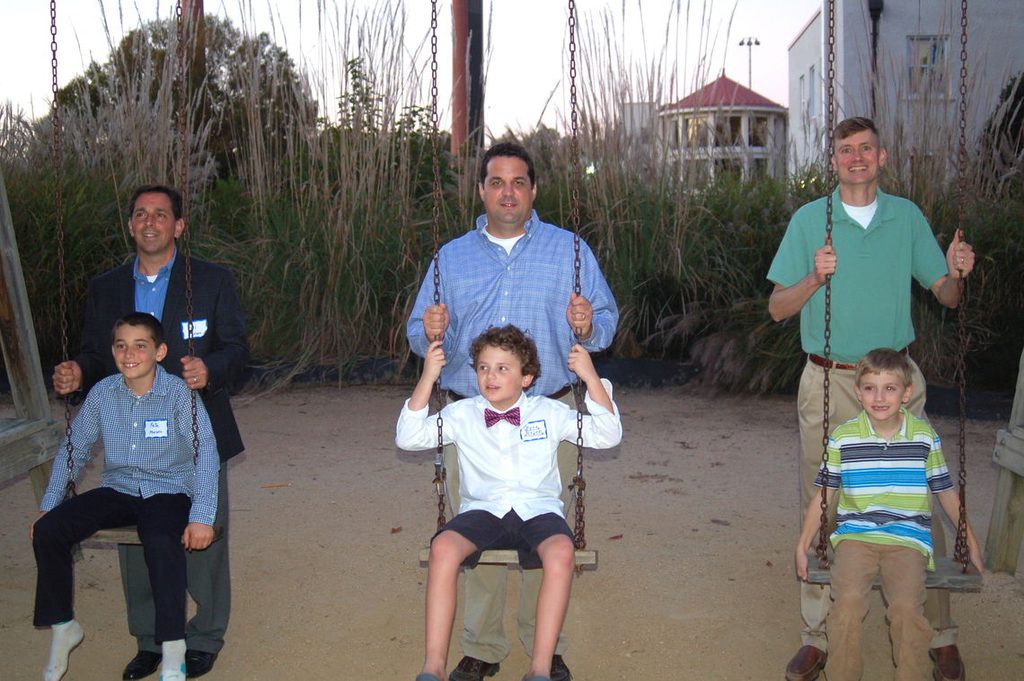
Three dads, friends of Peter Haughton, with their boys named in Haughton’s honor: Left to right are Bill Morano and Peter, Carl Ryden and Pete, and John Warner with Pete. (photo: submitted)
He still thinks about the couple of guys who kept up with him in that ninth-grade geometry class. “I went to Science and Math, they stayed. I saw the direction their lives took. They never got that love of learning, the chance to grow, that vision of what their lives could be,” he says. If anything, he hopes the NCSSM model can be expanded to reach more students.
“I love Carl’s excitement and passion for NCSSM,” says NCSSM Foundation President Katie Wagstaff. “He has lots of ideas. He’s excited to see NCSSM grow and serve North Carolina’s young people, making a difference in their educational outcomes, providing them with the best opportunities possible.”
“[Student potential] is our most rare and most precious resource in North Carolina, and we squander it every day,” Ryden says. “We’re still trying to solve Ms. Joyner’s problem — to make sure no student is not fully challenged.”