
Though part of life at NCSSM-Durham for decades, details of the painting in NCSSM-Durham’s Reynolds Breezeway remained elusive. (photo: Brian Faircloth)

Who is The Dude?
Before we tell you that, let us tell you what The Dude is. The Dude is the nickname given long ago by now NCSSM alumni to an enormous, unlabeled portrait that has hung on the wall of Reynolds Breezeway at NCSSM-Durham for almost as long as the school has existed. And as far as is known, no one at NCSSM has ever known who The Dude is. Despite that anonymity, The Dude has remained steadfast, perched in blue jeans and a tank top upon a stool next to a heating radiator, the tip of one foot upon the floor, hands clasped, an elbow upon a knee.
The Dude’s demeanor is a mystery, too. Calm? Introspective? Questioning the viewer? It’s a detail that may never be solved. But for all those students who for years passed by, looked up at the 9 feet tall by 6 feet wide painting, and thought, “Who is that?” we can now tell you.
But first, a little history.
Joe Liles, faculty emeritus, founding art instructor, and by most accounts the very first faculty member hired by NCSSM, likely has more knowledge of NCSSM’s early days than any other person associated with the school. His institutional memory is filled with gems. The Dude’s provenance, at least where NCSSM is concerned, is one of them.
Per Liles, The Dude arrived on permanent loan from the North Carolina Museum of Art in the early 80s. The museum, which for years was located in downtown Raleigh, was set to reopen in 1983 in its new location a few miles away on Blue Ridge Road, where it still stands today. Before it could move, however, it needed to reduce its inventory of pieces not on permanent display. Representatives from NCSSM, along with those from a number of other state entities, were invited to the museum to pick out something from that collection that they’d like to display back at their own institution.
“We jumped at the chance,” Liles says. And though he does not recall being part of the NCSSM entourage that selected the piece, he was “fully behind the whole operation and in favor of us accepting this.”
Liles feels confident that the piece made its way to NCSSM in 1982.
Still, the question remained. Who is The Dude?
“I heard many rumors about it from students who told me that it was a man, and many students at one point believed it was me,” Liles says. “They believed that in the background of the piece, you could tell that it was Beall Pavilion (a dormitory at NCSSM-Durham). It wasn’t me, of course. But they believed it was.”
So if it wasn’t Liles, then who is it?
The Dude is. . .
A woman. Her name is Frances Kuehn, and she is a New Jersey-born artist whose work has been shown at the Whitney Museum of American Art. Kuehn completed the acrylic on canvas piece hanging at NCSSM in 1972, the year after she completed the MFA program at Rutgers University. As an undergraduate, Kuehn attended Douglass College on scholarship, where she studied under the tutelage of Roy Lichtenstein, an influential figure in early Pop Art.
The painting’s title, “Hineni, A Self-Portrait,” is taken in part from the Hebrew utterance hineni, which means “Here am I!” or “Behold, this is me.”
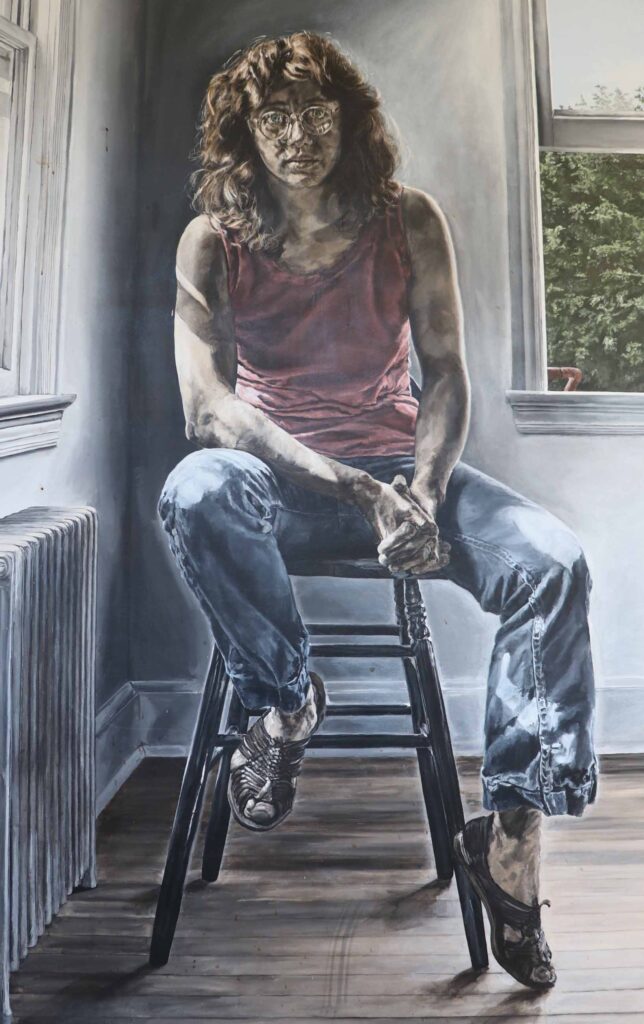
In the 2019 book “Women Artists on the Leading Edge: Visual Arts at Douglass College” by Joan Marter, Kuehn is described as a “realist” and an “expressionist” whose “compositions are broadly brushed, but more painterly than they appear in reproductions.”
Robbie Stoffel ’25 identified the artwork by utilizing a technology you’ve probably heard of. It’s called Google Image Search.
Yep. In a school full of students capable of engineering the impossible or curing the incurable, Stoffel simply loaded a photo of the work into Google and hit search.
Turns out the artist’s name wasn’t the only mystery surrounding the piece. Kuehn wasn’t entirely certain of the life Hineni had lived since it left her possession so many decades ago. Her website still features it as an early example of her figure painting. “I knew that the painting was in North Carolina, donated to an academic institution, but not sure exactly where,” she says. “It’s great to know that [it] is welcome and seen in its home.”
Mystery is appealing because of the curiosity it arouses. But in this instance, Stoffel thinks it’s good that the most enduring questions about the painting have now been resolved. “There is an alluring aspect to the mystery of it,” they say, “but I think it’s better that we know who the artist is, because people will now be able to look at Kuehn’s greater body of work.”
While it took more than 40 years to solve the mystery of The Dude, Liles suggests it could have been solved much sooner using an age-old investigative method.
“Has anyone,” he asks, “ever looked on the back of the painting to see if the artist had signed it?”
The NCSSM Foundation is ordering a plaque giving the work’s title, the artist’s name, the year of its creation, and crediting the North Carolina Museum of Art for providing the work on permanent loan.


