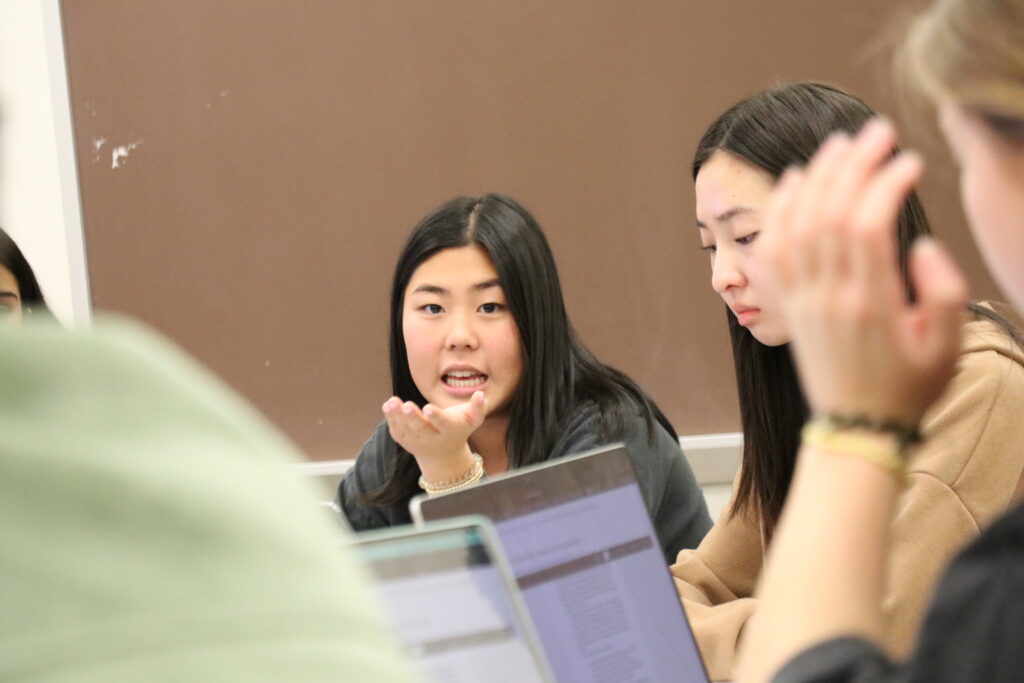
Acting as chair of the committee on the implementation of the Food Pyramid infographic, NCSSM-Durham senior Alissa Kurtzke, center, listens to debate among committee members along with NCSSM-Durham junior Reagan Brock (left). (photo: Brian Faircloth)
news
Students go back in time to debate national and international actions
This is the first in a series of stories on NCSSM’s January Term (J-Term), a special four-week break from NCSSM’s usual class schedule that allows students to delve deeply into a project of special interest. This year, nearly 150 courses are offered across the school’s Durham and Morganton campuses and around the world. Opportunities range from intensive lab experiences to classroom explorations and local field trips to travel to places like the western and northern United States, Central and South America, East Asia, the South Pacific, North Africa and Europe.
For a moment, it was 1991 and NCSSM students acting as representatives from the United States Department of Agriculture and the United States Department of Health and Human Services were in spirited debate at NCSSM-Durham. And it didn’t take long for conversations to grow a bit tense.
Five minutes earlier, the chair of the subcommittee – a student acting in the role of a U.S. senator – had gavelled into order the session on the publication of a brand new nutrition guide called the Food Pyramid, and already the department officials were going at it – challenging each other on assertions, countering each point. The conversation grew more crowded as lobbyists for the corn and cattle industries established their positions.
Almost at once, a number of questions had arisen. Who should have final authority over the pyramid? Did the pyramid take into consideration everything necessary? And would it be revised immediately (as Health and Human Services was requesting), immediately published as is (that’s what the USDA wanted), or should it be tabled until further consideration had been given (as suggested by the lobbyist)?
The chair of the committee brought the gavel down and everyone paused. “We’re starting to stray a little from the agenda,” they said.
That kind of exchange is at the core of Roleplaying History: The Politics of Agriculture, a J-Term course being led by Mike Limberg, an instructor of Mentorship and Research on the Durham campus.
“It’s a class about historical events,” he says, “and we’re looking at how politics is shaped by agriculture, by science, by international interests.”
The class, Limberg explains, is based on a pedagogy called “Reacting to the Past,” using immersive games published through the Reacting Consortium at Barnard College. It requires a lot of work from the students. “They have to research the science and the politics and the economics behind their roles,” he says, “and they have to make arguments for their particular point of view. They’re also competing with the interests of other characters to see who wins this particular scenario.”
Claire Gamache, an NCSSM-Morganton senior originally from Raleigh Charter High School, came to Durham for the course and found herself as one of the USDA representatives most on the hot seat. She chose the course, she explains during a five-minute break, because she thought it might move her outside of her comfort zone.
“That,” she says, “is exactly what’s happening. Some of my best friends are going against me right now, and the emotions are very much real. I still very much get anxious, flustered, I don’t know what to say, and I’m speechless at times, but when I’m able to just speak and look around and see that everyone is listening, it’s the most fulfilling thing.”
NCSSM-Morganton senior Gina Byon, speaking, played the role of an official from the U.S. Department of Health and Human Services as did Lily Fang (right), an NCSSM-Durham junior. (photo: Brian Faircloth)
Danny Martin is an NCSSM-Durham senior from Research Triangle High School. He is square in the middle of his comfort zone in this course.
“I enjoy debating a lot,” he says, “and I’m interested in politics and economics and that kind of thing. And I’ve done things like Model UN, so I saw this class and I thought this would be a really fantastic way to practice debating.”
It’s only the first day of the roleplaying, but already Claire and Danny are learning from the experience, in part because they have found themselves advocating for positions that, in reality, they don’t personally support.
“I’m going against my own personal beliefs,” Claire says, but she has bought so thoroughly into her role that at one point she says to an inquisitor, “What do you want me to do, lie to you?” The whole group dissolves into laughter.
Danny is learning to genuinely consider other sides of an argument, too. “I can still say as Danny Martin, ‘I don’t agree with this,’ but I can also say, ‘I completely understand how, when you have this experience, and you’re coming from that perspective, your argument is rational.’”
There will be no consensus today. Tomorrow they will try again, and then it’s on to the late 1990s, with students assuming the roles of international representatives and officials from NGOs to debate providing famine aid for North Korea while the country directs funding toward missile development.
Claire is eager for what’s next. “I am so grateful that NCSSM provides this J-Term opportunity. I don’t know what I would do without it. Since last year I’ve learned how to fence, I’ve learned how to mold clay, and now I’m learning how to debate. It’s indescribable.”