
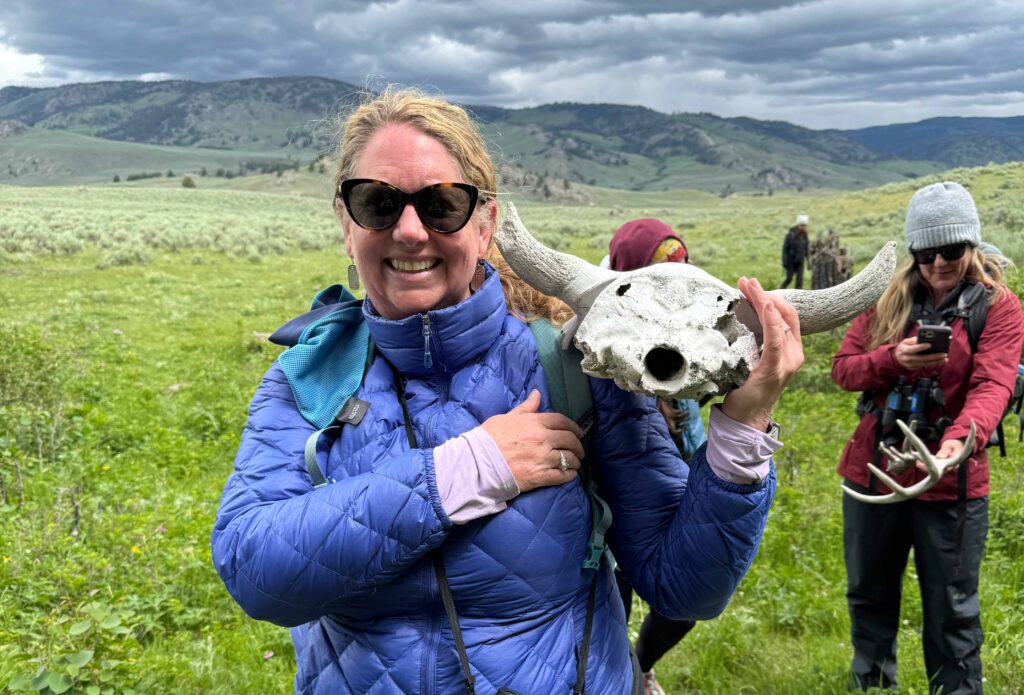
Whether in the classroom or outside of school, the outdoors is a common thread through Peeples’ life. (photo: Liz Peeples)

Liz Peeples, a humanities instructor at NCSSM-Durham, has been awarded the UNC Board of Governors Award for Excellence in Teaching.
Given by the university system each year to an outstanding teacher nominated by special committees at each of the UNC System schools, the award – as noted by UNC Board of Governors Chair Wendy Murphy – recognizes “talented faculty [who] have dedicated their lives to mentoring and supporting our students.”
The award from one of the nation’s best public university systems is a recognition of Peeples’ unfailing commitment to using literature to help her students navigate the “beautiful mess” that is life. The thing is, Peeples says, it wasn’t originally supposed to be this way.
Two years into a bachelor’s degree in special education at Vanderbilt University, Peeples was asked by a professor in the program to describe what her ideal classroom would look like.
Until that point, Peeples was certain she was right where she was meant to be. While a high school sophomore in Sarasota, Florida, she was introduced to Special Olympics by her history teacher, who had a child with special needs. So strong was this newfound passion for young people facing exceptional challenges that soon she was volunteering several times a week as a coach with the local chapter. By her senior year, she had grown so fond of the young people she worked with that she filled two empty slots in her academic schedule with volunteer activity as a peer counselor-slash-tutor in local schools where, among others, she worked with an at-risk elementary student and a young boy with profound intellectual and physical challenges.
“My mom, my dad, my grandparents, they all taught me that if there’s work to be done and you can do it, you should do it right?” Peeples recalls. “And I loved doing that work. And so I thought, ‘This is what I’m going to do. I’m going to be a special ed teacher.’”

To understand Peeples’ subconscious path to becoming a literature teacher, however, you have to back up a few years to her first year of high school and the first novel – “Marjorie Morningstar” by Herman Wouk – to fully capture her attention. Go even further back, all the way to her childhood, and you’ll find her with her grandparents at plays and operas and the Ringling Museum of Art in Sarasota.
The novel, the museums, the plays and operas, Peeples says, all resonated with her at an instinctive level. And so, too, did her work with Special Olympics. “I just felt so connected to humanity,” she says of them all, “and all the various ways of being human.”
But then came that simple question posed to her in a college classroom.
The way Peeples answered it reset everything. “I started thinking back to all the classes I loved in high school, and when I finished telling all this to the teacher, she looked at me and said, ‘You just described an English literature classroom.’
“I was like, ‘Well, I guess I’m in the wrong major’” Peeples says. By day’s end, she had changed majors. And two years later, at the age of 22, she was in a literature classroom at Hoggard High School in Wilmington, her first full-time, real-life, salary-and-benefits job as a teacher, dressed professionally in a suit because she thought that, being just four years older than many of her students, she had to be at least a little intimidating.
Turns out that the person who was intimidated was Peeples, intimidated by a “tall, big, tough-looking kid” whose untied shoelaces beat about his scuffed-up Timberland boots with every step as he approached her where she stood outside the door of her classroom on her very first day, roster in hand as she met her new students.
“Normally I was absolutely comfortable in front of students, but suddenly I was terrified by this kid as he came walking up to me,” she says. “I thought, ‘What authority do I actually have here?’”
That meeting would turn out to be a pivotal moment in Peeple’s development as a teacher. The teenage boy who frightened her could barely read. So she taught him. Her literature classroom became a safe space for him.
“It’s like what my family taught me, right?” Peeples says. “‘If there’s work to do and you can do it, you should do it.’ So I did it. And I think he felt seen by a teacher as a person for perhaps the first time ever.”
After three years in Wilmington, Peeples moved to the brand-new Wakefield High School in Raleigh, where she helped build the AP Language program and ran the student paper.
Peeples learned to manage a classroom at Hoggard, but at Wakefield she began to dig deep into the AP curriculum, seeking out ways to connect students’ lives with the complicated stories and novels they read. “I had to learn how to build a space,” she says, “where the kids trusted me and each other enough to have the hard conversations that these works sometimes require of us.” Among those works was “The Things They Carried,” a 1991 Pulitzer Prize finalist novel about the war in Vietnam written by Tim O’Brien.
Jonathan Booton was a student of Peeples’ at Wakefield from 2003 to 2006. He read “The Things They Carried” in her class when he was 16. Just a few years later, he read it again while embedded as a Navy Corpsman with a Marine outfit in heavy combat in Afghanistan. He read the book again after returning home. Each time, he found new meaning in the pages, meaning he was able to discover thanks in part to Peeples’ guidance.
“I credit her for teaching me how to look for secondary and tertiary meanings within literature,” he says. “It would not have occurred to me that the book was a story about someone trying to reach catharsis. It would have just been a war story without her guiding my interpretation at first. Once I had that understanding, I could take the training wheels off a little bit more and figure out more by myself.”
For almost 20 years now, Booton has remained in regular contact with Peeples, but not because of the recommendations he gets for what to read next. Booton thinks of Peeples as family. She was there for him, he says, when he became a father while still in high school. She held a baby shower for him and his partner after class, and was at the hospital within 30 minutes of his son being born.
“That level of genuine care and advocacy, I think that was the first time I’d seen it by someone that didn’t have to do that, you know? She didn’t owe us anything outside of a grade, but she actually cared about us and was invested in us.”
Peeples loved Wakefield, but by 2008 she was beginning to feel constrained by instructional edicts being passed down from on high. She joined NCSSM that same year, inspired by the curricular freedom NCSSM allowed instructors.
Though she’s taught a number of different courses in her career at NCSSM, one that has remained consistent has been American Studies, which combines American literature and history into a single course. The curriculum and its rigor was familiar to Peeples, but it took a while, she says, to get used to NCSSM’s team approach to teaching the course. Meredith Murphy ’02, a historian, instructor and NCSSM-Durham’s Chair of Humanities, partnered with her for 14 years in the course.
“I was so fortunate to have Meredith as my teaching partner,” Peeples says. “As an alum, she understood the NCSSM culture and she has such a deep understanding of our country’s history. I learned so much history from her, and it totally changed the way I think about literature in some ways.”
“Liz loves teaching,” Murphy says. “She’s so excited to engage with the students and to meet them where they are. And so she’s one of the teachers I know will always be learning something new and incorporating it into her classes and keeping her classes really fresh, and that made it fun to co-teach with her. And I can tell when I’ve got a student in my class who was in her class the previous semester. I can tell by how they participate in the class discussion and how they bring an understanding of historical context into an analysis of a literary text.”
Peeples’ path to NCSSM began with a life-changing revelation, but she feels pretty certain at this point that there are no such surprises ahead between now and retirement, whenever that may be. She’s in no big hurry.
“It’s magical here,” she says. “I feel so lucky in so many ways. Lucky in that my professor asked me to think about what my ideal classroom would look like, lucky that I was able to make that vision a true vision, and lucky that I get to work with amazing students and amazing colleagues. I do believe that this is where I was meant to be.”
“She’s one of the good ones, and definitely deserves all the credit she can get,” Booton says.


