
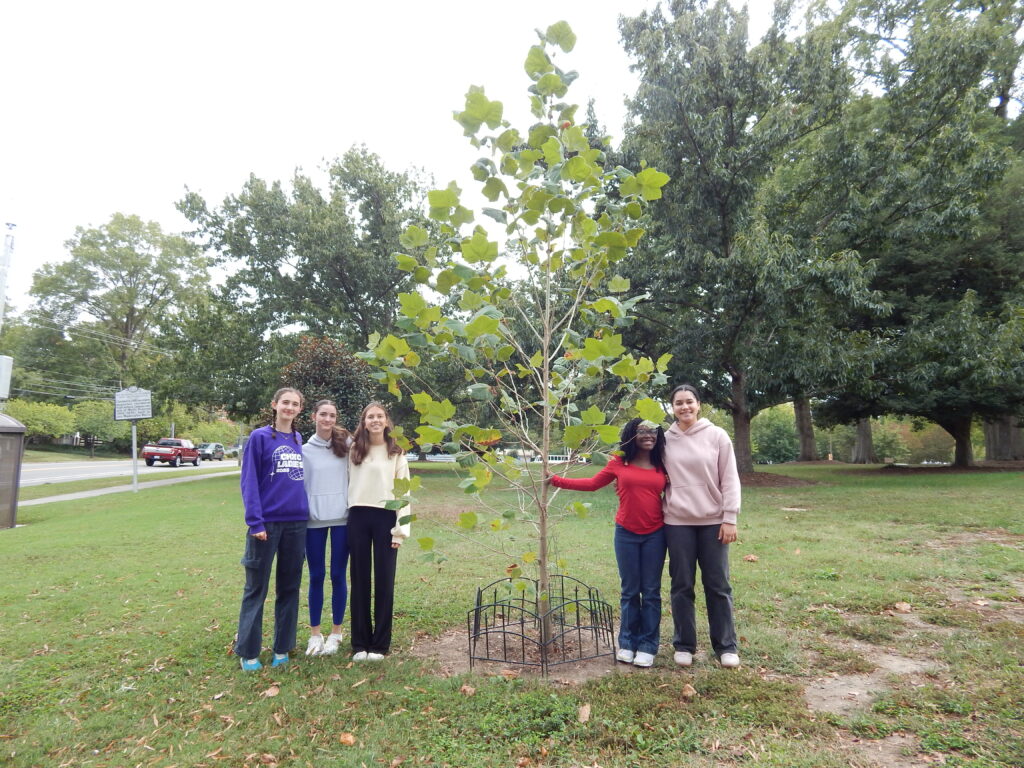
Faculty at NCSSM-Durham helped tuck in the campus's newest American sycamore, which orbited the Moon as a seedling. (photo: Beatrice Moss)

On the Durham and Morganton campuses of North Carolina School of Science and Mathematics live two young, but very special, trees. One, an American sycamore, flourishes in the company of Durham’s history-soaked oaks. The other, an American sweetgum, grows in the rolling foothills of Morganton.
Since their planting in the spring of 2024, each tree has grown from a bare, slender sapling of 30-ish inches into tall adolescents with an expanding canopy of broad leaves that reach for the sky in the spring and summer.
Both trees may be among the youngest residents on NCSSM’s arboreal block, but they’ve already got something on their leafy elders: these trees are NASA-named Moon trees.
While still seeds, NCSSM’s newest trees hitched a ride toward the Moon aboard an uncrewed Orion spacecraft that lifted off from Kennedy Space Center in November of 2022. Orion and its cargo remained in space for nearly a month where it performed two fly-bys of Earth’s nearest neighbor, getting as close as 80 miles from its cratered surface, before returning home. Called Artemis 1, the mission was part of a scheduled series of flights designed to set the stage for NASA’s eventual lunar surface return. (In addition to being stewards of these special trees, NCSSM has an additional thread rooting it to earth and space and NASA’s Artemis program: astronaut Christina Hammock Koch ’97 , who holds the record as an International Space Station resident for the longest stay in space by a woman and who is scheduled to circle the Moon sometime in 2026 as part of Artemis II, making her the first woman to travel beyond low-Earth orbit.)
Though Orion was absent of astronauts this time around, the sycamore and sweetgum weren’t alone. With them were an estimated 1,000 to 2,000 seeds from five different tree species. By the time Orion and its cargo returned to Earth, settling into the Pacific Ocean beneath a trio of billowing parachutes, the seeds had traveled 1.3 million miles.
The Moon trees were part of a national STEM engagement and conservation education initiative, and were the result of a partnership between NASA’s Office of STEM Engagement and the U.S. Department of Agriculture Forest Services. It’s not the first time tree seeds have left our world for another.
The Moon tree program started in 1971 when astronaut Stuart Roosa, a former U.S. Forest Service smoke jumper, flew into space with hundreds of tree seeds during the Apollo 14 mission. Once back on Earth the seeds were germinated and then distributed to institutions across the country for planting.
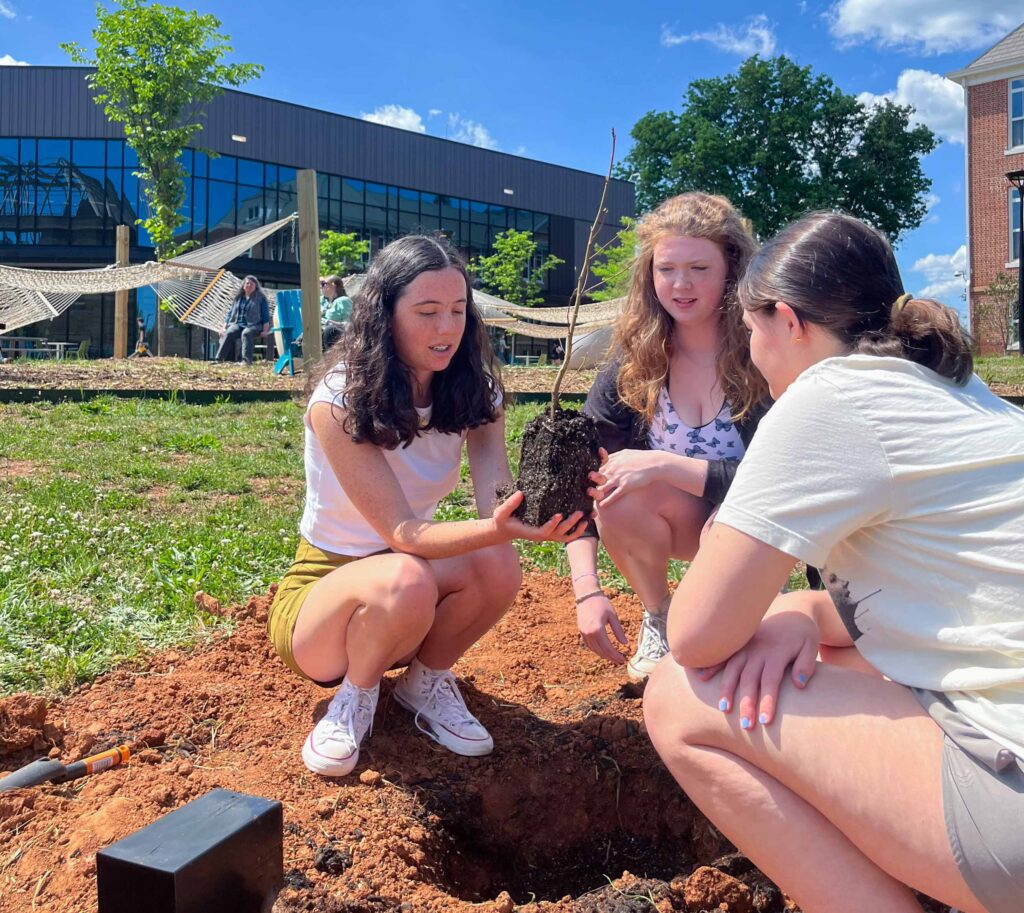
The Artemis Moon trees followed that same blueprint. NCSSM was one of 12 organizations in North Carolina to receive such well-travelled saplings.
Because the trees are so unique, NASA selected recipients through a detailed application process. Erin Quinlan, an Instructor of Biology at NCSSM-Durham, was part of the team that prepared NCSSM’s submission.
“We worked hard on that proposal,” she says. “NASA needed information like, ‘What’s the soil like? Do you have foresters that are going to check in on it and make sure that it’s healthy? How are you going to take care of it? Where will it be located on campus? How accessible will it be to both our students and the community?’”
Todd Bollinger, NCSSM’s grounds supervisor in Durham, assumed the tremendous responsibility for that campus’s tree.
“I worry about that tree all the time,” Bollinger says. “I mean, there’s a little bit of pressure on you to keep this thing alive. If something happened, you can’t just go buy another Moon tree.”
Bollinger had the forethought to plant a sister sycamore on campus so students could do comparisons between the two. With a few more years of growth, Quinlan says, both trees should be ready for student analyses.
“There’s a lot our students will be able to do,” she says. “They’ll be able to look at things like growth patterns and chlorophyll levels in the trees. When it starts to produce fruit, they can investigate whether its fruit-bearing is normal for a tree its age. There are some molecular plans for it as well where students will investigate genetic markers in the Moon tree and compare them to those from wild ones.”
Lucy Safir, a Durham senior originally from Chapel Hill High School, is intrigued by the sycamore’s backstory and its capacity for change. “That tree has traveled more than I have!” she says. “It’s really awesome that we have a chance to track its growth. I got to see it when it was just a little baby, but if you think about students here in the future, how will they see the tree? How will it look different?”
NCSSM’s campuses applied individually for a tree. Lindsay Smith, a biology instructor at NCSSM-Morganton, supervised a team of three students in her environmental science courses who prepared Morganton’s application. Those students have since graduated, but Morganton’s current scholars have a lot of curiosity about the campus’s unique sweetgum.
“When they hear about the story of Moon trees and that this originally started with the Apollo missions and that they are now planted all over the country, they think it’s pretty cool and special to be one of the institutions that have a Moon tree,” Smith says. “They’re looking forward to watching it grow and become part of a legacy.”
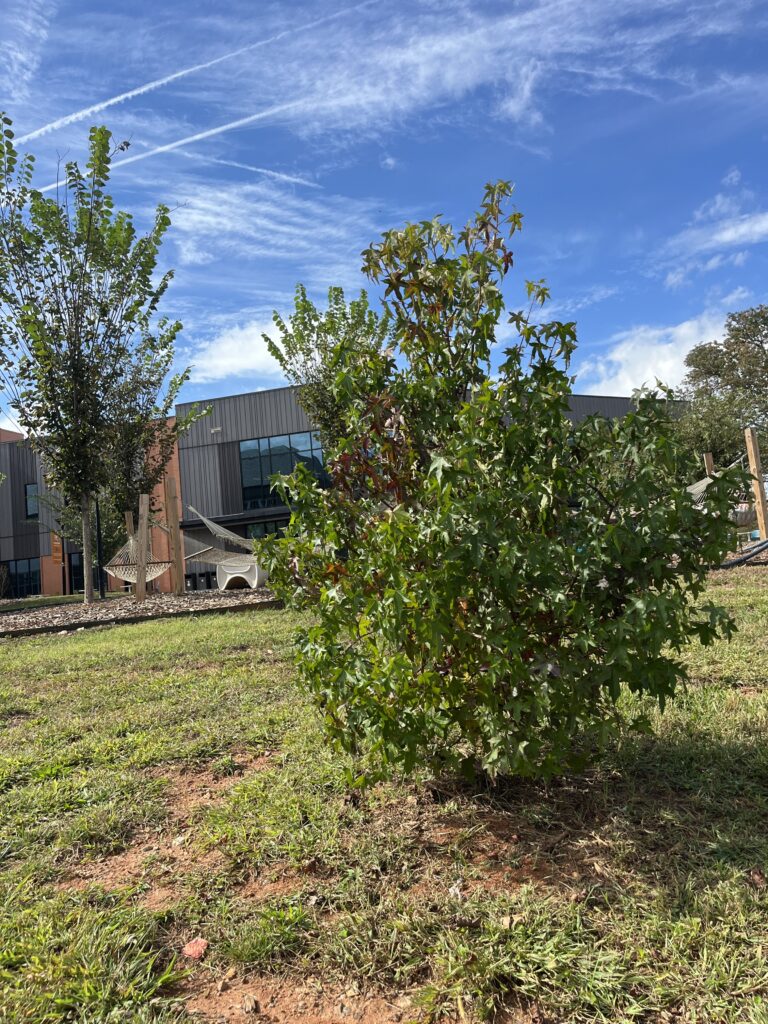
Sarah Craige, a Morganton senior originally from Myers Park High School in Charlotte, is eyeing a future in astrobiology. What fascinates her about the sweetgum on her campus is its resiliency.
“It looks right now like this cute little tree in a peaceful area of campus, but it has left our planet, orbited the Moon, gone into deeper space, and then re-entered our atmosphere. And then, once it was planted, it went through Hurricane Helene. It’s been through some really harsh conditions, and I feel like it says a lot about humanity, too, about how things can go through so much and still be thriving at the end of it.”
If all goes well for, oh, the next 200 to 400 years, NCSSM’s Moon trees should remain a source of admiration, a resource for study, and a testament to patience and resilience. And should a student pass them by on a moonlit night, perhaps they’ll find inspiration in the light that silvers their leaves.


