
More than 100 students from throughout North Carolina participated in NCSSM's 36 hour SMathHacks hackathon. (Photo: submitted)

NCSSM seniors Arnav Maniar and Vasu Bansal were under pressure. As participants in the school’s sixth annual SMathHacks hackathon in early February, they and 102 other students from throughout North Carolina each had 36 hours – from Saturday morning to Sunday afternoon – to build a functional hardware or software project related to the competition’s space and aeronautics theme.
That’s not much time, acknowledges Michael D’Argenio, a computer science instructor at NCSSM who has served for the last three years as one of the hackathon’s faculty sponsors. But that’s the whole point of SMathHacks.
“The tight timeframe for the hackathon provides a good opportunity for students to test out and create a project in a single weekend, usually a proof of concept, and see what they truly are capable of when pushed,” he says. “When the weekend’s over, they leave with something that they’re pretty proud of.”
SMathHacks originated as an informal, completely student-run event but has grown larger and more organized. This year, the hackathon included seven corporate sponsors, two keynote speakers, seven workshop leaders, 17 technical advisors, and 21 judges. Student participants included NCSSM Residential and Online students as well as others from high schools across the state who engaged remotely. Participants could choose from one of four specialized tracks: Web & Mobile Applications; Hardware; Explanatory Modeling & Computational Science; and AI & Machine Learning.
Arnav, who came to NCSSM-Morganton from East Mecklenburg High School in Charlotte, chose to compete as a solo hacker in the Web and Mobile Applications track. The hackathon provided him the perfect opportunity to further develop a side project he had started in an astrophysics course at NCSSM.
“I wanted to create a gravitational simulation app that could help someone visualize how something set loose in space – say, a spacecraft – might move around due to the gravitational pull of the Earth or the moon, or any other celestial body that might act upon it,” he says. “I already had a little bit of info I could work off from, so I decided to scrap all the garbage code that wasn’t useful anymore and build it back up from the core idea.”

Vasu, who came to NCSSM-Durham from Ardrey Kell High School in Charlotte, chose Explanatory Modeling and Computational Science. Unlike Arnav, Vasu entered the hackathon with a blank slate.
“I kind of walked in blind and saw where it took me,” he says.
Lucky for Vasu, the theme was space and aeronautics. Since he was a child, he had been fascinated by the drama of rocket launches with all their flames and plumes. He kept coming back to those scenes as he considered ideas for a project. Had anyone ever tried to track the spread of exhausts from launches? When a literature search turned up scant attempts, Vasu realized he had his project: a dashboard that uses resources such as heat maps, weather data, and atmospheric modeling with machine learning to show how pollutants spread throughout the atmosphere after a rocket launch.
“If space travel is the future,” Vasu says, “then we want to have the most sustainable way to do it so we don’t harm our planet in the process.”
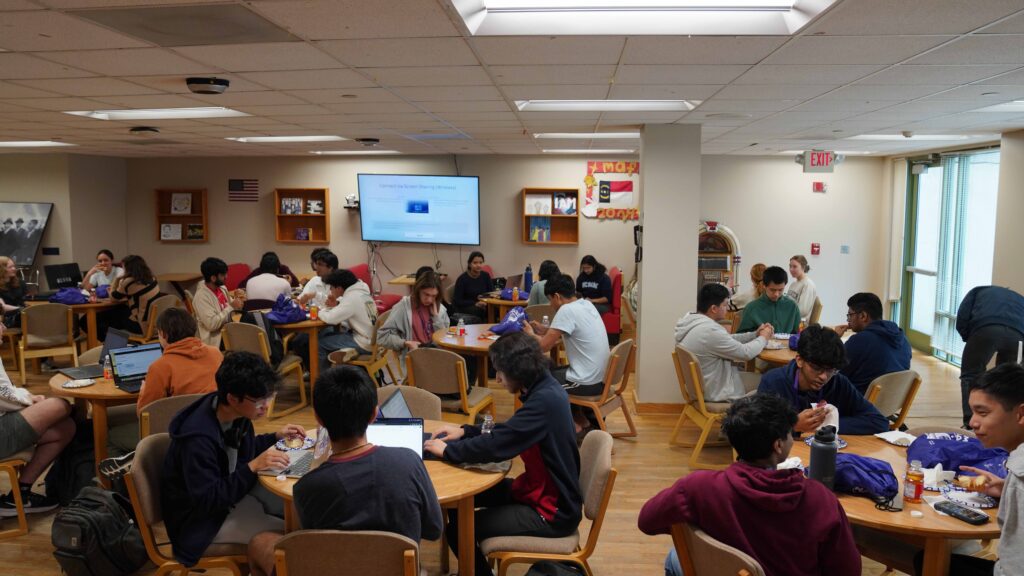
This is the second year that NCSSM-Morganton senior Annabel Balami, a Cary resident who came to NCSSM from Wake Young Women’s Leadership Academy, has served in a leadership role in the hackathon. The experience, she says, “has really changed my perspective on what people do behind the scenes to make things work. I really learned the value of collaboration and communication and have come to value that so much more because of being on the leadership team.”
Though outside the usual curriculum at NCSSM, SMathHacks and other unique experiences throughout the year are a key part of what makes NCSSM so inspirational and transformative for students.
“The entire event, from start to finish, was exciting and adrenaline pumping,” Vasu says. “I was surrounded by so many of my peers who were hard at work, everyone just trying to flesh out a project that they’re really proud of. And it kind of made me want to work even harder at that moment. Seeing other people’s successes really makes you want to see your own success.”
Also providing essential support for SMathHacks were Brian Sea as a faculty sponsor in Morganton, Charlotte Crawford ’25 as a student organizer in Morganton, and Nandini Aggarwal ’25, a student organizer in Durham.


