
The entrepreneurship program at NCSSM opened a new path of discovery for Israel James ’25. (photo: submitted)

Israel James ’25 had no understanding of entrepreneurship when he saw HU 4000 Entrepreneurship in the NCSSM course catalog prior to the beginning of his senior year in Durham.
“I love rocks and minerals and climate change mitigation,” the new alum and University of Pennsylvania freshman says. “I had no inkling about entrepreneurship prior to seeing that course in the catalog.”
That unfamiliarity led James to do exactly what NCSSM encourages all of its students to do: try something new.
Three weeks into the course, taught by Chad Keister, Instructor of Economics and Social Science, James had discovered a new – and unexpected – passion.
“It was just amazing,” he says. “We were learning so much about market segmentation, customer discovery, ideation. Honestly, that class opened my eyes to a whole new world.”
For many, the word “entrepreneurship” is misunderstood, often eliciting thoughts of private entities created to maximize financial profit. But that’s not what entrepreneurship really is, says Keister. “For sure, profit allows an effort to sustain itself. But there’s more to it than that. In the end, entrepreneurship is about taking an idea and making it valuable to others. And that success can be measured in so many ways beyond profit margin.”
One of those measures is an idea’s impact on the greater good. That struck a chord with James. “I just loved that, through entrepreneurship, I could wrap all of my interests – interest in research, interest in climate change and carbon sequestration – into something that I genuinely am invested in, and something that could be so much bigger than all of us.”
James teamed up with some of his classmates on an idea called Terrabite, which in some respects was similar to James’ junior year research. Terrabite propositions turning food waste into biochar – charcoal, essentially – which is then sealed inside concrete on construction sites.
Midway through the course, the Terrabite team presented their idea to a group of savvy alumni of the entrepreneurship course invited to campus by Keister.
The audience, Keister says, challenged the Terrabite team.
“The room was packed, and they just hammered the team with questions. The audience was positive, right, but they were just hammering the Terrabite team with very pointed and legitimate questions that needed to be asked. Israel [James] ended up handling most of the pitch. Totally calm when fielding their questions.
“When it was over, Israel thanked them all for their questions, and then he sat down with the team, and he said that basically, the folks with questions and concerns were right.
“But here’s the thing. He said the questioners were right, but only up to a point. He and his teammates knew they were right, too, and that they had something there. And so, Israel proceeded to lead that team into iterating and pivoting and tweaking the business model. They stuck with the idea and developed a beautiful prototype.”
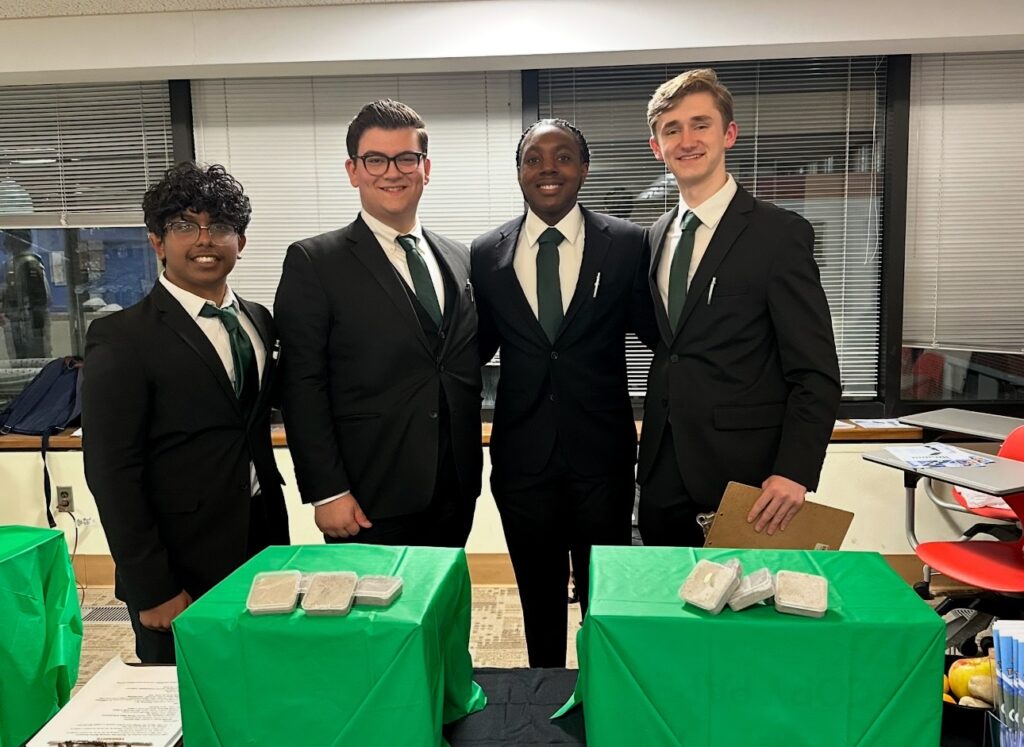
At the end of the e-ship course, the project teams participated in an entrepreneurship fair at NCSSM, hosted in partnership with NCSSM’s Colopy Entrepreneurship Program, a collaboration between NCSSM’s administration, faculty, and Joe Colopy, a Durham entrepreneur and generous friend of the school who, along with his wife, Karalyn, have invested in the future of NCSSM and its students by creating the Colopy Family Endowment for Technology Entrepreneurship. Two awards were up for grabs at the fair: Most Innovative Project, and Most Likely to Turn a Profit.
Terrabite won both.
“This kid,” Keister says of James, “is a bright, genuine, authentic, kind person with high character, compassion and empathy. But he has grit, too, and that’s often a differentiator.”
Though the course ended, James and his teammates continued to develop their idea during the next semester, this time with the help of the Colopy Entrepreneurship Program, and its director, Chip Bobbert. Once a week, James and his partners met with Bobbert after school to discuss the project and ways to further build it out. The Colopy Program offers mentorship and grants to help students further develop their ideas. From many angles, Bobbert says, the program closely resembles an independent studies class, or an extracurricular activity.
Israel’s experience, Bobbert says, is a perfect example of what the Colopy Entrepreneurship Program is working to build: an interdisciplinary program that uses the full suite of services that NCSSM has to offer – science, math, the humanities, and the entrepreneurship program – to come up with a product that holds value for society.
That James established the baseline for Terrabite while still in high school introduces another critical element of the e-ship program at NCSSM.
“A lot of students aren’t engaging in innovation and entrepreneurship programs until later in their undergraduate career, typically not until their senior year,” Bobbert says. “We here at NCSSM want to put these programs into secondary institutions. Training their brain to start working that way when they’re 22 years old, when they’re in their senior year of college, isn’t the right time. A student is simply going to learn better when they’re younger.”
As important as fostering entrepreneurial thinking at an earlier age is, one of the most actionable things the Colopy Entrepreneurship Program does is connect students with real-world players in the e-ship arena.
That’s how James became involved with an organization this past summer called Launch Chapel Hill.
At Bobbert’s urging, James volunteered at an e-ship event called Grep-a-Palooza, a full-day conference focusing on early-stage technology startups in North Carolina that was created and is hosted by Joe Colopy. There, James met Emil Runge, the director of Launch Chapel Hill, a start-up accelerator and coworking space originally created from a partnership between the Town of Chapel Hill and the University of North Carolina at Chapel Hill.
So impressed with James was Runge that he encouraged him to take advantage of some of Launch Chapel Hill’s services.
James enrolled in a Launch course called Intro to Ideation, followed by another called Rams to Riches.
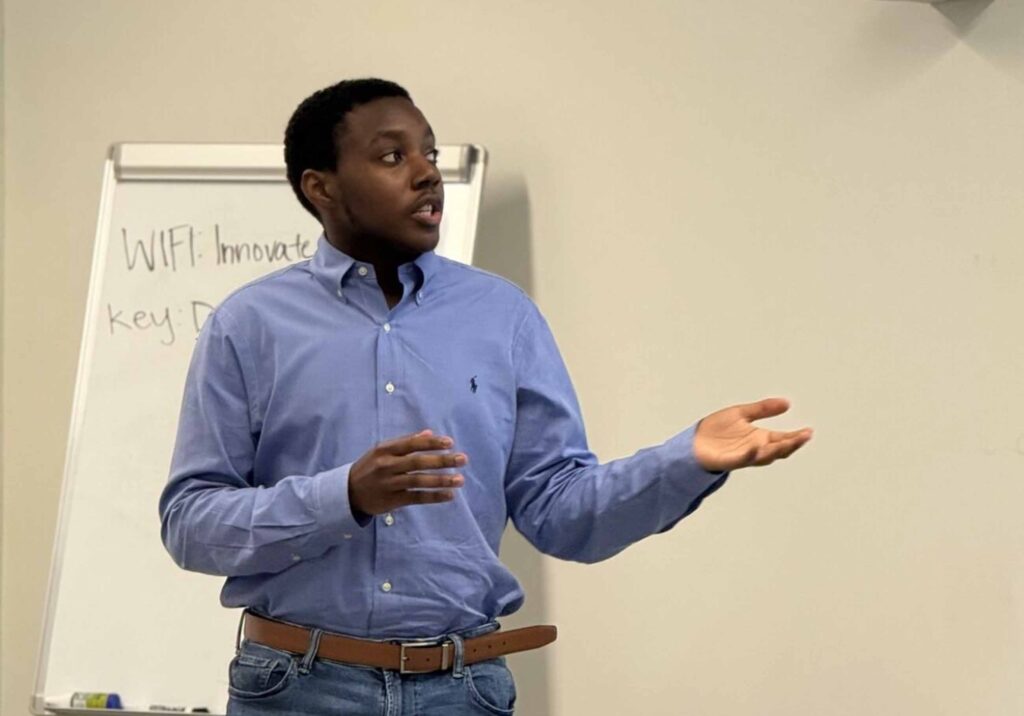
“These courses deepened my understanding of customer discovery, market validation, pitch strategy, and business model development,” James says. “The guidance and the structure of these courses pushed me to think critically, iterate quickly, and lead more confidently.”
James’ engagement with Launch eventually landed him in a pitch meeting in front of his most powerful audience yet: representatives from the U.S. National Science Foundation Innovation Corps, which helps facilitate commercialization of an idea.
With his freshman year at UPenn now underway, James is turning some of his attention to the pursuit of a degree in and a possible primary career as a geologist, but he’s not easing his foot off the Terrabite throttle.
“This isn’t something that I’m going to leave behind,” he says. “This is something that I’m going to continue even after I’m out of college. But none of this would have been possible without NCSSM’s commitment to empowering student innovators. Mr. Keister’s foundational course and Mr. Chip Bobbert’s leadership of the Colopy Entrepreneurship Program gave me the confidence, tools, and technical vocabulary to step into professional rooms and be taken seriously.”


