
Independent research at NCSSM is flourishing thanks in large part to private giving.
news
Alumni-established endowment funds independent student research at NCSSM

February 14, 2025
news

The owl is long gone by now. For a while last year it had made its evening roost in Joiner Hall, a building under significant renovation on the campus of North Carolina School of Science and Mathematics in Morganton. But with renovations nearing completion, the owl has moved on to more appropriate accommodations.
It’s a mystery what kind of owl it was. Adrija Sarkar ’25, who came to NCSSM-Morganton from East Mecklenburg High School in Charlotte theorizes that it might have been a barn owl, but she can’t be sure. As far as she can tell, no one at the school actually ever saw the silent-flying bird with the heart-shaped face. It had definitely been there, though; there was evidence all over the floor.
What Adrija and a team of fellow student researchers found were owl pellets; or, to be more descriptive, the regurgitated, undigested remains of small critters consumed by the owl. Sometimes roundish, sometimes oblong-ish, these pellets typically contain bones, teeth, feathers and fur. While that may sound a tad gross to the squeamish, they’re fascinating finds for inquisitive scientific minds, for in them is a world of information about an owl’s dining habits and the creatures that inhabit the local ecosystem.
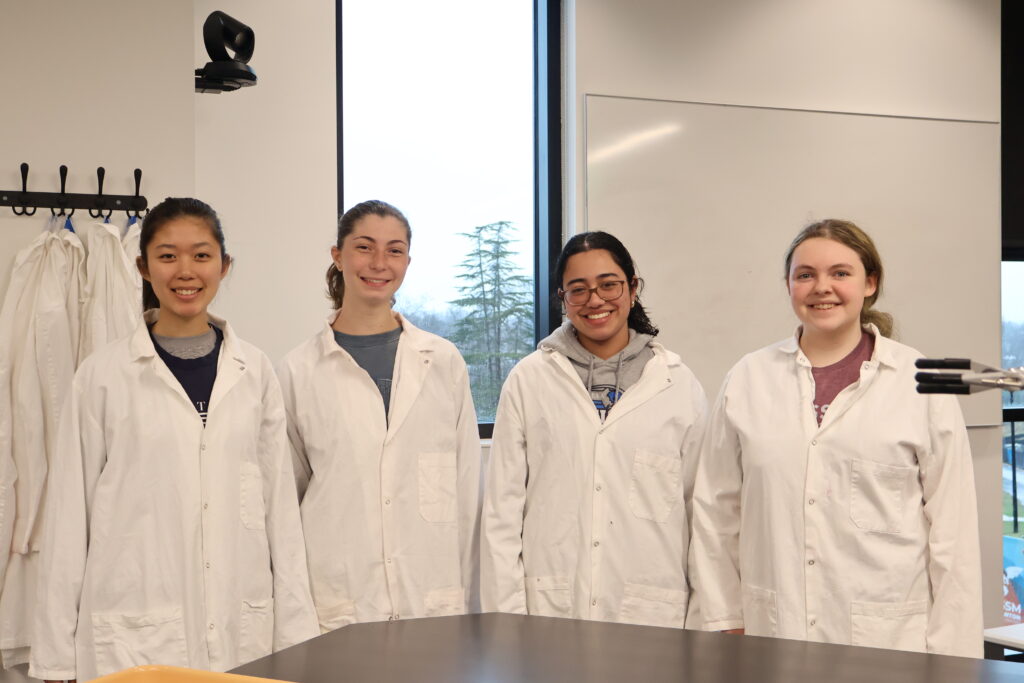
Whatever species of owl it was, it was certainly a hungry one. The pellets collected by the team – Adrija and fellow seniors Meghan Leonard, originally from Ardrey Kell High School in Charlotte; Lauren Yu, originally from Watauga High School in Boone; and Emily Brissenden, a Catawba native originally from Discovery High School – are part of an independent research project begun last year by a previous group of students. Together, the two teams gathered so many samples that a new group of students should be able to continue the research next year.
DNA analysis of the pellets so far has revealed that the owl had a fondness for hispid cotton rats and woodland voles. It’s debatable whether they were actually residents of the NCSSM campus proper – their suspected nemesis, after all, is known to travel three or four miles by air in search of food – but it’s highly likely they were at least Burke County residents.
Making the research possible for Adrija and her teammates is funding they received from the Bowman-Brockman Endowment for Entrepreneurship & Advanced Research. Established by alumni Jud Bowman ’99, Taylor Brockman ’99, as well as fellow donor Steve Nelson, and managed by the NCSSM Foundation, the fund each year supports a number of independent research projects through a submission and review process. This year, the review committee selected 13 projects across both of NCSSM’s campuses.
“Bowman-Brockman has been really amazing for us in terms of funding,”Adrija said of the endowment’s support. “Without it we would not have been able to afford things like the DNA analysis kits and the primers that we needed to pull out and analyze DNA. It’s also allowing us to add new people to our study and give them hands-on research experience as well.”
Brailliant
The idea behind NCSSM-Durham junior Richard Shan’s Bowman-Brockman funded project came about while the Charlotte native was still enrolled at Charlotte Latin School, his previous high school. Richard had interacted with someone who is low-vision, and had personally seen their frustrations with exorbitantly expensive and inefficient Braille converters on the market.
Richard’s creative and entrepreneurial mind was piqued. How could he address both of those challenges? Once on the Durham campus, an idea he had been tinkering with finally began to take shape.
Along with his partners Sumedh Kotrannavar, an NCSSM-Durham senior originally from Raleigh’s William G. Enloe High School, and Tejjas Kaul, an NCSSM Online senior from Panther Creek High School in Cary, Richard set about developing Brailliant, a portable real-time translation device. By using a combination of off-the-shelf components and custom-made parts fabricated in NCSSM-Durham’s Fabrication Lab, the team was able to create a fully functional device that could retail for as low as $300. That’s just a fraction of the $2,000-plus retail of similar text-to-Braille converters, Richard says.
What makes Brailliant particularly attractive at its price point is that it uses a feature that many high-end Braille converters don’t: a camera.
“Many of the consumer-level text-to-Braille converters currently on the market can’t convert in live-time or use a camera,” Richard says. “Text has to first be typed in. That’s self-defeating, and it still might cost thousands of dollars.”
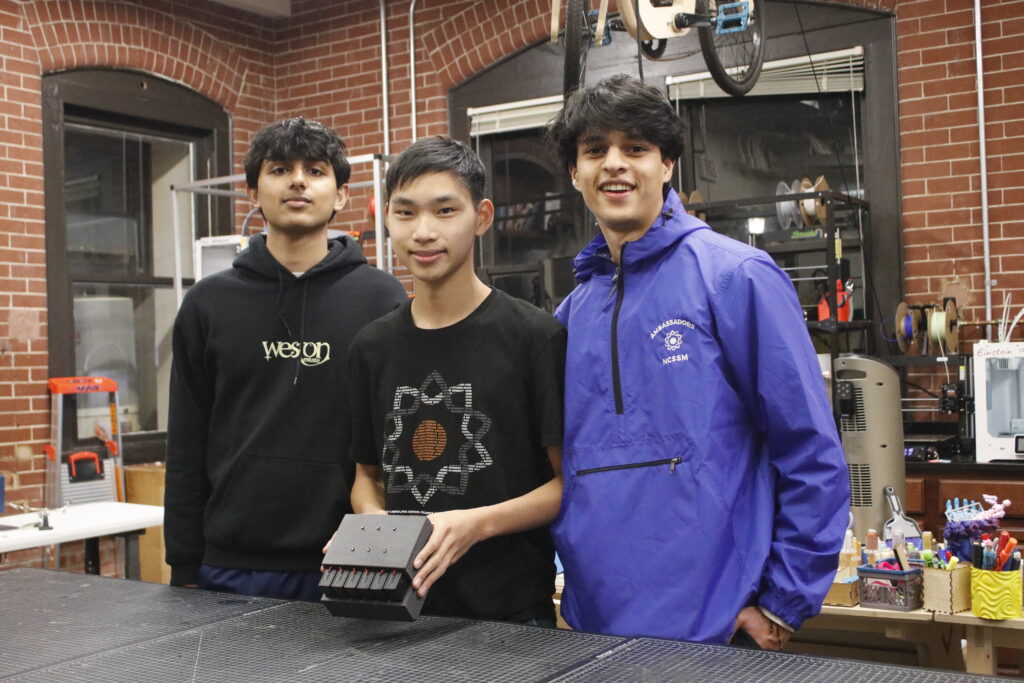
With Brailliant, a user can manage the entire process end-to-end on their own, starting with a small custom-designed camera the user points at text. Through the magic of engineering and programming, the image is then translated into Braille for the user to read on the device’s display. It all happens fast; the total time from photograph to Braille is approximately five seconds. At its highest settings, Brailliant can render up to seven characters per second on its display.
But that’s not all. Making Brailliant even more unique, Richard says, is its ability to do something no other Braille converter has even been able to do: convert scenes to Braille using the same onboard camera and an AI-based technology Richard calls scene2braille. “For the first time ever,” he says, “users will be able to see the world around them by having a picture or scene described to them.”
Richard, who handles the engineering and outreach while his teammates manage marketing and web development, has built and tested multiple prototypes as quickly as possible, revising and refining the product after each iteration in a process he calls “fast failure.” As expected, it’s a materials-heavy approach. That’s where the Bowman-Brockman endowment comes in. With it, the Brailliant team has been able to purchase much needed supplies to further fast-track their design and get it closer to a final, marketable product.
“Every time I design a new iteration, sometimes it works, and sometimes it’s only a little bit better. So I have to keep going, keep designing newer and better iterations,” Richard says. “That’s where the Bowman-Brockman funds have been so helpful. The endowment has enabled us to buy a bunch of parts and equipment and launch a fully functioning website.”
Amy Sheck, NCSSM’s Dean of Science and the facilitator of the Bowman-Brockman endowment, says the endowment is a key part of the NCSSM experience. “We have talented, smart, capable students who are interested in learning beyond the classroom,” she says. “These kinds of projects are all independent research, so the students completely own them. That takes a different level of maturity, but if they have ideas, we should try to nurture them. That’s exactly what this endowment allows us as faculty and staff to do.”


