Dr. Jory Weintraub, Director of Science Engagement at NCSU, addressed students at each of the three Division Awards Ceremonies of the North Carolina Science and Engineering Fair: Elementary, Junior, and Senior. NCSU has hosted the fair since 2018. (photo: Tom Williams)
news
NC Science and Engineering Fair a “peak” experience
NC Science and Engineering Fair a “peak” experience
Print
Share
John Guillen Mendoza, now a junior at Duplin Early College High School in Kenansville, and Johnathan Charleston, a 2025 graduate of NCSSM-Durham, may come from different schools, but they both found themselves with more than 450 students in grades 3-12 at the 37th North Carolina Science and Engineering Fair this past spring at North Carolina State University in Raleigh. One hundred fifty STEM field experts acting as competition judges awaited them, eager to hear about the research the students had poured their hearts into.
The scene at NCSU was the culmination of months, and sometimes even years, of research conducted by students from throughout North Carolina. Participants had to work their way through a series of local and 10 regional science and engineering fairs to get to Raleigh where they found themselves in the company of hundreds of other students from throughout North Carolina who followed their passion to Raleigh.
For many students, the fair is what Tom Williams calls a “peak experience.” For 17 years Williams, the current director of the fair and a retired educator, has been volunteering in various capacities with the organization. He also sits on the board of the North Carolina Science Fair Foundation, a 100% volunteer-driven nonprofit organization which funds the Science and Engineering Fair’s operations.
“I always said when I was a high school principal and a school system superintendent that I wanted every kid who came through our schools to have a peak experience by the time they graduated from high school, whether it was in sports or the band or theater or FFA or whatever. This fair is an excellent opportunity for students throughout the state to have just such an opportunity.”
It certainly was for John, who hails from the small southeastern community of Chinquapin in Duplin County. John’s involvement in the state fair began with a visit one recent summer to a jobsite with his construction industry father. As John watched walls go up, his analytical, engineering mind that is “always thinking about new ideas to benefit society” kicked into gear. If the temporary walls he saw under construction were braced with timbers running at angles, what if such angles were incorporated into the finished walls in place of the typical vertical and horizontal framing members? Surely the angles would provide enhanced structural strength and greater resistance to forces like hurricanes and earthquakes.
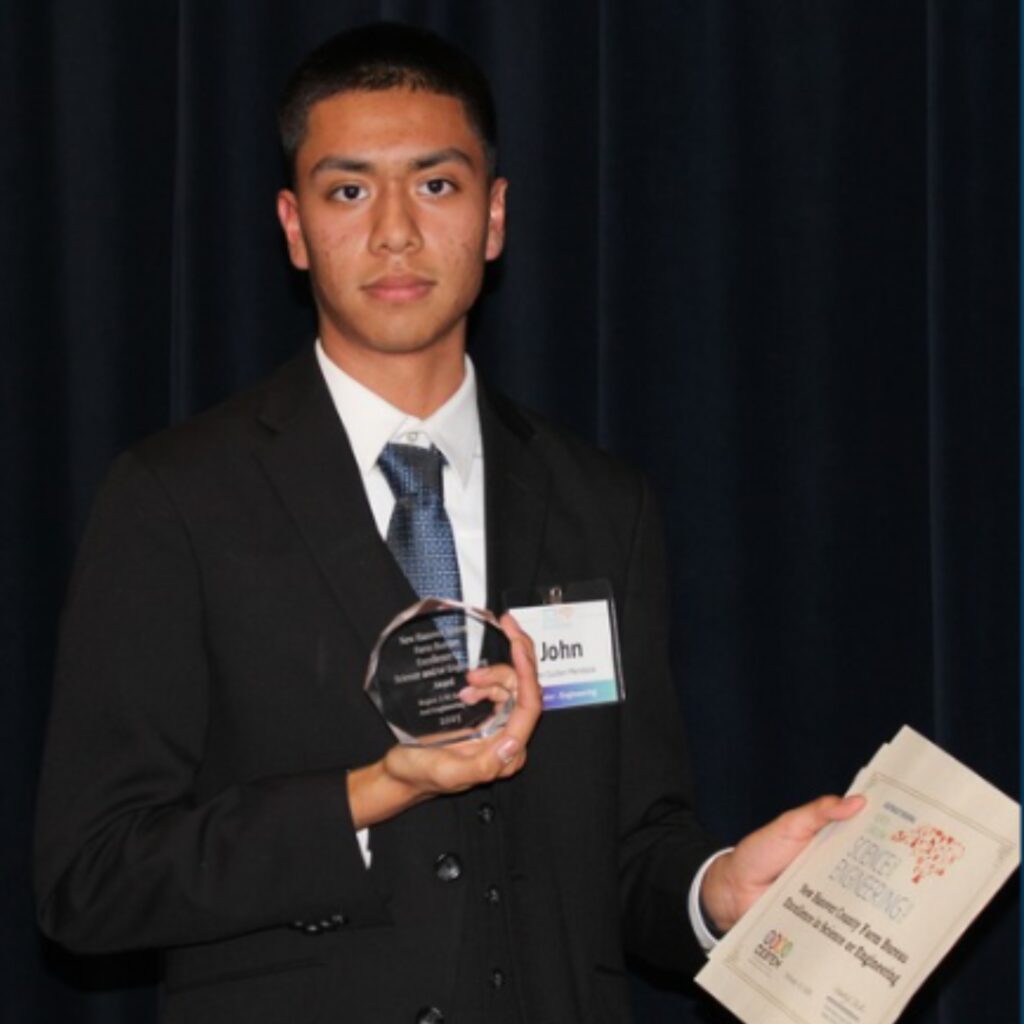
John Guillen Mendoza’s special recognition at the Southeast Regional Science and Engineering Fair advanced him to the North Carolina Science and Engineering Fair. (photo: Duplin County Schools)
Back home, John immediately began developing his idea. He called it StormQuake Wall, and modeled a scaled-down version using common crafting materials like popsicle sticks, glue and foam board. He used circular saws and windblowers to test the models. John even designed and built a unique apparatus to forcefully shake the models. StormQuake Wall so impressed the judges at the county science fair that it earned John a trip to the Southeast Regional Science and Engineering Fair, held at UNC-Wilmington. There John won third place in the Senior Engineering Category and earned special recognition with an Outstanding Creative Award which advanced him to the state science fair held in Raleigh. “It was,” John says, “a great experience. It really gave me a chance to become competitive for scholarships and even allowed me to have a shot at competing in the International Science and Engineering Fair.”
ISEF, as the world’s oldest and most prestigious international STEM research competition for high school students, is a big draw for participants at the state level. For a number of years now, the North Carolina Science and Engineering Fair has been a state-level affiliate of ISEF, which is currently sponsored by the global biotech firm Regeneron and owned and operated by the DC-based nonprofit Society for Science. While the state fair ultimately functions as its own entity, the formal relationship between it and ISEF means that the 12 top projects at the state level move on to compete in ISEF, with all travel and registration expenses for the participants borne by the North Carolina Science Fair Foundation.
Such support at the state level ensures fairness and equity of access, says Williams who, with other board members, spends a considerable amount of his time as a volunteer encouraging contributions to the foundation from corporate and private donors. “We want,” he says,” to make sure that the North Carolina kids who advance to ISEF do so based solely on the quality of their research, not the ability of their family to pay.”
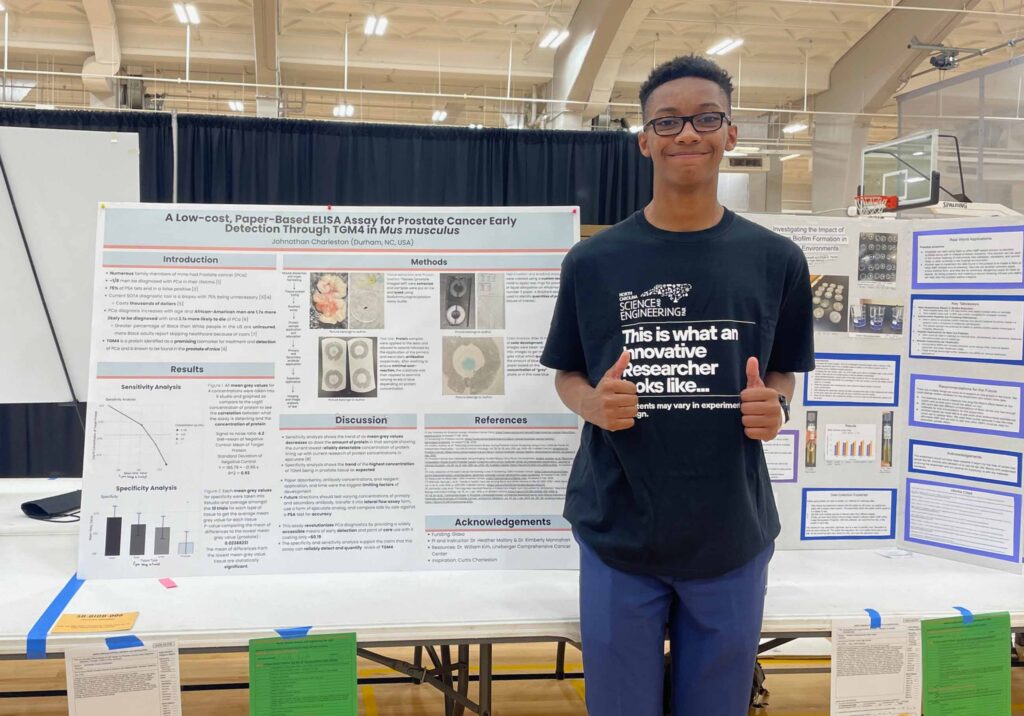
Like John, the path NCSSM’s Johnathan Charleston took to the state fair led through a regional fair, but is rooted in family medical history that goes back generations. A number of men on the paternal side of his family – including most recently his father, grandfather and uncles – have all dealt with prostate cancer.
The diagnostics Johnathan watched his father endure were unpleasant, he says. “They were expensive and invasive. No one really wants to get them. I realized something better could be done, so I focused on that really hard.”
Johnathan Charleston’s work in detecting prostate cancer was inspired by family medical history. (photo: Kim Monahan)
What Johnathan came up with was a inexpensive paper-based test, much like a covid test or a pregnancy test, that measured the amount of protein in male bodily fluid. Changes in the level of proteins could indicate the presence of prostate cancer, or the severity of it. Johnathan began his research during his junior year at NCSSM, carried it through the summer, and continued it into his senior year where he entered it into the NCSEF Region 3B Science and Engineering fair held at NCSSM-Durham, where it won third place in its division and earned him the trip to the North Carolina Science and Engineering Fair.
Inspired by his experience with StormQuake Wall, John Mendoza is already at work on his next idea, which he hopes will carry him back to Raleigh, and perhaps even beyond. Though he’s keeping the details under wraps for now, it’s called Neutral Network, and its aim is to prevent war and conflict.
Johnathan Charleston is now in college at UNC-Chapel Hill, where he hopes to continue developing the prostate cancer test he created. No matter the direction the next few years will take him, he says he’s already a different and better person for having been a part of the North Carolina Science and Engineering Fair.
“Growing up, kids around me would always pick on me for being interested in whatever nerdy topics I was interested in. But having people at the fair be genuinely interested in what I had to say about my research, like, it healed a part of me, honestly. I’ll never forget getting to talk to all those judges, and getting to talk to my peers about the research we’ve been doing. I felt the same excitement I felt as a child.”
There are so many more students out there like John and Johnathan who are pouring so much of themselves into ideas that could benefit all of humanity, says Williams, the state fair director. His call to action is clear.
“These students are giving us their best. It’s only fair that we invest in them. In fact, it’s vital that we do so. The support we provide them is really, in the end, an effort to help ourselves. These kids are the next generation of problem solvers, and we’re counting on them – we’re relying on them, actually – to be there. We need them. But they need us, too.”