
Pi is forever, but these tattoos celebrating Pi Week were temporary. (photo: Robin Beets)

For fans of math, March 14 is a big deal.
Why? Because it’s Pi (3.14) day! Exciting, right?
So much so that NCSSM-Morganton spent the entire week leading up to Pi Day celebrating the joy of mathematics with a series of fun, math-based events.
The sneaky thing about the Pi Week activities is that they were based in sophisticated, modeling-based mathematics, a defining feature of how math is taught at NCSSM, says NCSSM-Morganton mathematics chair Reed Hubbard: “What makes us really unique is that, instead of saying to students, ‘Okay, here’s some basic math, here are some rules, and now here’s a contrived problem,’ we are asking them open-ended questions about real problems, and then showing them that math is a tool to solve those problems.”
Twists and Tangles
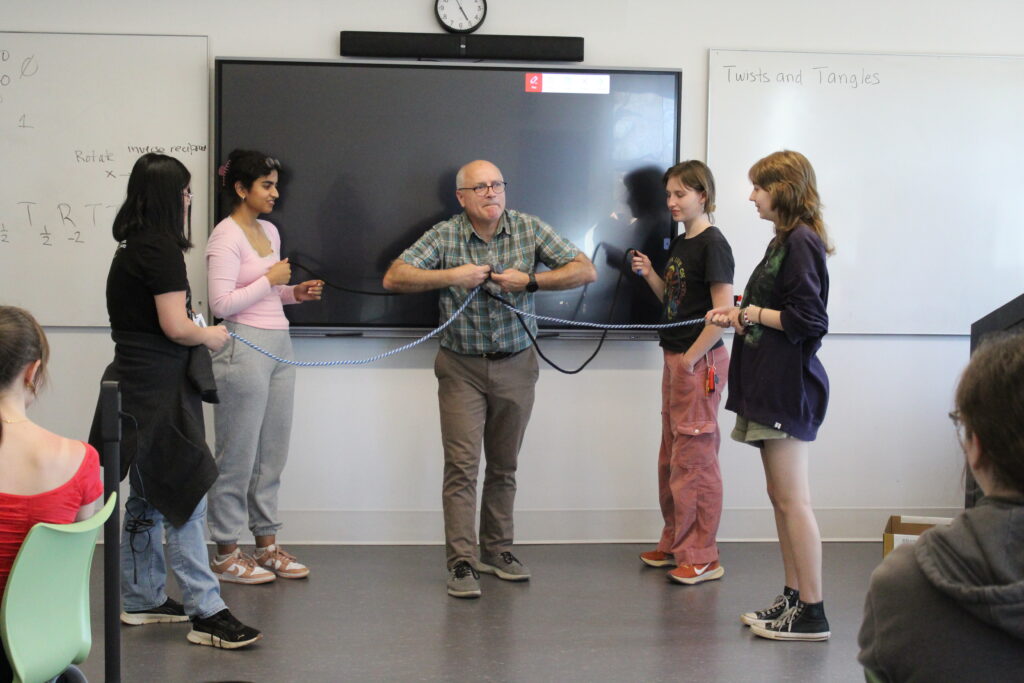
One problem that math can help solve is the untangling of knots, demonstrated Bryan Stutzman ’83, a math instructor at NCSSM-Morganton, in his “Twists and Tangles” activity.
“The Twists and Tangles talk had as its basis making an abstract concept concrete by having pairs of students in front of the audience tangling together two ropes and then working together with the audience to figure out how to use math to untangle them,” Stutzman says. “The tools we used were basic fractions and algebra but it has underpinnings in high-level math for those who want to go further.”
“I hadn’t really thought extensively about how much math there was in something like untangling a knot,” says Jacob Binder, a senior in the activity who joined NCSSM from Northwest Guilford High School. “At first, it looks random, but when you really get into it and see that there is a mathematical method to the madness, that there is a system behind what’s going on instead of just trial and error, it’s really surprising.”
That he could explore the complex mathematics behind something seemingly as simple as untangling a shoelace was just a fraction of the many benefits of studying math at NCSSM, Jacob added. “I’ve been exposed not only to a more advanced math curriculum here, but to a wider variety of it as well,” he says. “I just wouldn’t have gotten much exposure anywhere else to things like knot theory or graph theory.”
The Circus of Mathematics
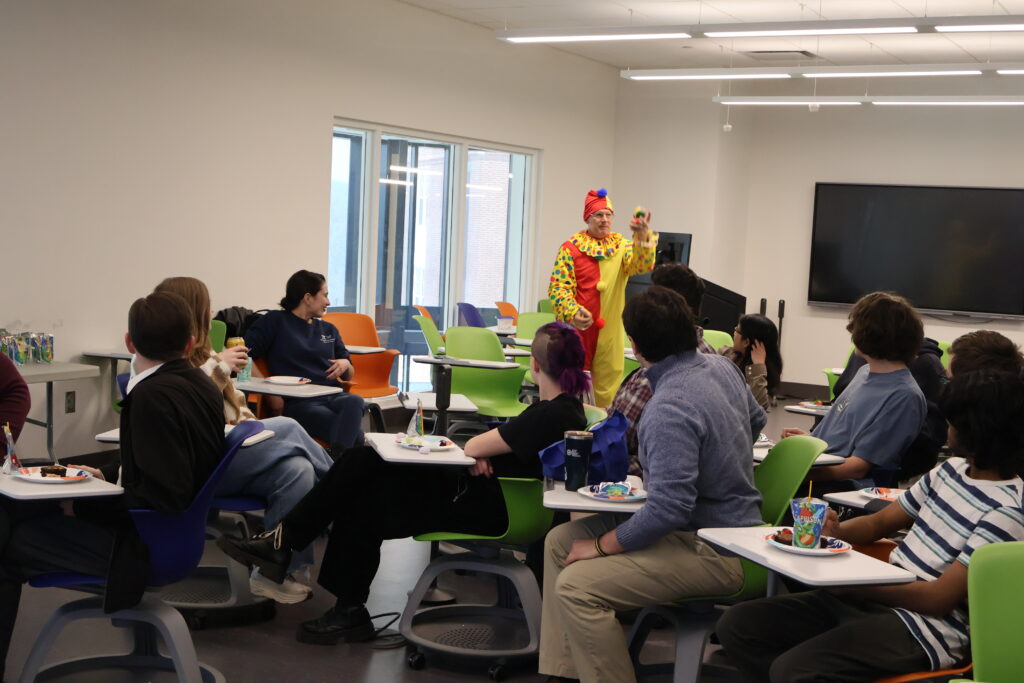
To the casual observer, circus clowns juggling bowling pins and twisting balloons into animals is pure entertainment. What they might not realize is that they’re watching math in action.
The students in “The Circus of Mathematics,” led by math instructor Hannah Schwartz, used combinatorics and graph theory to grasp the concept.
“A juggling pattern is basically a sequence of numbers,” says Schwartz. “Twisting balloons into shapes is the same. Identifying sequences and assigning numbers to them helps you to figure out what patterns can actually be juggled, or what shapes can or can’t be tied with a certain number of balloons. And you can prove this with math.”
Jacob Rodriguez, a Morganton junior originally from Caldwell Early High School in Hudson, had long known there had to be some math involved in juggling and balloon twisting. He just didn’t know how much.
“I figured, like, there must be a way you can break it down,” he says. “I had no idea it went that deep and that there is a whole field about it and it has so many applications. I just thought it was some trick somebody had figured out a long time ago, right?”
That math is such an integral part of everyday life is a recognition born in no small part, Jacob continues, from the curiosity of faculty and staff at NCSSM.
“You are reminded of that here a lot. There’s a lot of examples that we get of real world applications of math on any scale. It definitely does make you think about how you can really look at anything – and I mean literally anything – and break it down into how it works mathematically. That has reminded me to enjoy math, have fun with it, and use the skills we learn and apply them in a fun way.”
Estimathon
While the math wasn’t quite as complicated, students in the Estimathon still had plenty of work cut out for them, says math instructor Samantha Moore. Moore served as the faculty liaison between NCSSM-Morganton and Jane Street, an international research-driven trading firm, philanthropic friend of the school, and presenter of the event who sent representatives from the firm’s New York City office to Morganton to guide students in making educated guesses based on prompts.
“Estimating can be a tricky thing,” Moore says. “Sometimes you don’t always have clear data, so you have to use reason, and use what you do know, to figure out what numbers to multiply or divide. I think it was enlightening for students to do math in that way.”
It certainly was for Juliet Wang, a junior from Ardrey Kell High School in Charlotte. She and her activity partner had 30 minutes to estimate how many numbers under one million were divisible by the sum of their digits. Time ran out before they could settle on a final answer, but estimating isn’t a precise, right or wrong exercise anyway.
“For a lot of this stuff there’s not really a lot of classroom math, I guess you’d call it, that you can apply. You have to sort of work your way through your real world knowledge and general estimation skills to try to get to the answer for that.”
Juliet participated in multiple Pi Week activities, and in each she was struck by the unique approach to problem solving. It’s a real plus, she says, of her overall experience in NCSSM’s classrooms.
“The way that topics like math are taught here includes a lot of student engagement,” she says. “There’s a lot of alternative teaching methods, too. I find that to be a lot more engaging, and it has kind of reminded me that math can be fun.”


