
Anthien Nguyen, a senior at NCSSM-Durham who did mentorship work in labs at UNC-Chapel Hill this summer, was one of 96 NCSSM students who participated in the summer mentorship program. (photo: Brian Faircloth)

The summer mentorship opportunity that excited NCSSM Online senior Jack Arthur the most was at the Highlands Biological Station in North Carolina’s southern Blue Ridge Mountains. The research station, which is part of Western Carolina University, is 450 miles away from Jack’s home in New Bern, near the coast. He didn’t let that stop him from pursuing his interest in environmental science.
“Just because it was seven hours away didn’t mean that I wasn’t gonna do it right, right?” he says.
Jack spent five weeks bunking at WCU in Cullowhee at night, and staying busy with field and lab work during the day at the research center in Highlands about an hour south, not far from North Carolina’s border with Georgia and South Carolina.
It’s not the kind of research opportunity high schoolers often get. In fact, Jack and one other student from NCSSM were the only high school students working on formal research projects with undergraduates and Biological Station staff this summer.
At first, Jack says, the work he was doing with bird-banding, water quality, and microplastics seemed novel and exciting. But over the course of the five weeks, it began to feel almost “routine,” he says. But not routine as in repetitive or boring. Routine in that it began to feel less like a unique, one-off experience and more like a daily part of who he was, and what his life might look like one day should he continue to pursue an interest in environmental science.
“When that realization hit me, I was pretty happy,” Jack says. “The opportunity to go and do something like that for five weeks was just something that I’m really grateful for.”
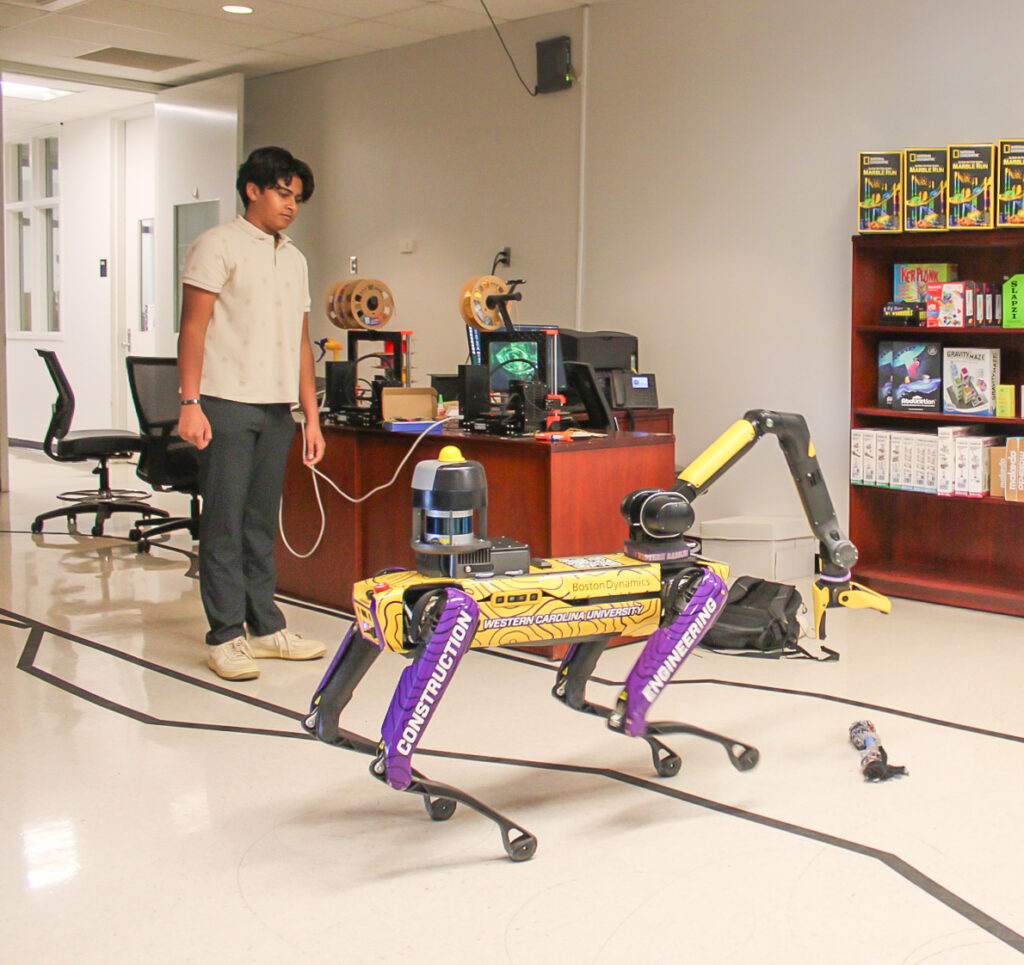
Riya Reddy, an NCSSM-M0rganton senior from Marvin Ridge High School, spent part of her summer in Western North Carolina as well, though she wasn’t swatting mosquitoes or wading through mountain streams on a near-daily basis like Jack. Riya stayed close to WCU’s College of Engineering and Technology where she worked in the school’s Rapid Center, a research and development facility that works with industries, businesses, and entrepreneurs to enhance the economy of western North Carolina through product development. For five weeks Riya explored her academic and career interests in engineering by working with a partner to create a belt that, when worn by visually-impaired individuals, used sensors and and actuators to alert them to objects in their path.
Five weeks might seem like plenty of time to develop a working prototype, but Riya learned that the research and development process, especially when starting from scratch, can be incredibly time consuming. There was brainstorming to do and refining the idea and CAD design. There was the development of a materials list and a budget and the manufacturing and acquisition of parts. At times, Riya says, it was all going on simultaneously.
“It wasn’t a linear process,” Riya says. “We were still researching while we were building. A lot of the parts didn’t work the first time and we had to 3D print them several times. We definitely ran into a lot of different issues, but we kept trying to troubleshoot them. I was surprised by how much trial and error it took. That was a big part of the project.”
From those failures, Riya gained the most value from the experience. “I think it proved how self-sufficient I can be when problem solving,” she says. “It was really frustrating sometimes, but I’m really proud of the way that my partner and I just continued working.”
Mia Aiello, a Residential senior on NCSSM’s Durham campus who came to the school from the Early College Program at Blue Ridge Community College in Asheville, has always been interested in cardiology. While she’s still working out whether she wants to work in the research side or the clinical side, she’s got a much better understanding of the research side after having spent her summer mentorship working in the labs in UNC-Chapel Hill’s Department of Medicine. There, she got to immerse herself in hands-on lab work on an existing research project in nephrology.
Such immersion is not typically available during the regular school year, she says.
“By doing that research in the summer, I could really just focus solely on the research aspect. I didn’t have to balance school along with doing research. I also liked that I was going to be able to experience what a full day in the lab would look like. During the school year, you only go, like, two times a week for a total of four hours. Getting that high concentration of time in the lab was really interesting.”
By the time the mentorship was over, Mia’s early assumptions about the work environment in real-world labs were completely shattered.
“I was in a professional environment, so I kind of expected it to be a lot more serious in a way,” she says. “There were definitely times where you had to focus. But whenever I actually got to interact with the different lab members, it was nice to see that it was actually a much more relaxed environment. That made me less nervous. It was very easy to exist in that space.”
Easy to exist: that may be one of the most important lessons to be gained from NCSSM’s mentorship program. Through it, students gain not only a deeper understanding of what they may or may not be interested in pursuing further, but they also find that the skills and confidence they have gained at NCSSM make it much easier for them to go into unfamiliar situations and find that comfortable spot where they can thrive.


