Regeneron Science Talent Search Finalist bridges Western and…
Print
Share
UPDATE: She’s a winner! Ava Cummings ’25 just took home second place in the final round of the Regeneron Science Talent Search in Washington, D.C. Congratulations, Ava!
When, as a middle schooler, Ava Cummings ’25 walked into a science fair hosted by Durham’s Hillside High School, she was in awe. Though participating in the middle school division, the Smithfield native wandered into a side room reserved especially for students from North Carolina School of Science and Mathematics who were presenting research.
“I looked around at all the projects, and they had these big, fancy titles that I couldn’t understand, and I was just shocked,” she says. “I was like, ‘How does someone do something like this in 11th and 12th grade?’”
Now she knows. For the past year, the NCSSM-Durham senior has conducted research into a rare genetic disorder called STAC3 – also known as Native American Myopathy – that was first identified in the 1980s among members of the Lumbee, a Native American tribe centered in North Carolina’s Robeson County. Ava’s work on the condition has earned her a spot among 40 finalists in the prestigious international 2025 Regeneron Science Talent Search, which reviewed research from nearly 2,500 students from almost 800 high schools who entered the competition.
Ava was familiar with STAC3 disorder before she even began her research; she is Lumbee and has seen first-hand among family friends the damage the condition can cause.
Present at birth, STAC3 affects an individual’s muscle strength and tone which, in turn, leads to a host of other complications, many of which can be severely debilitating in the worst cases.
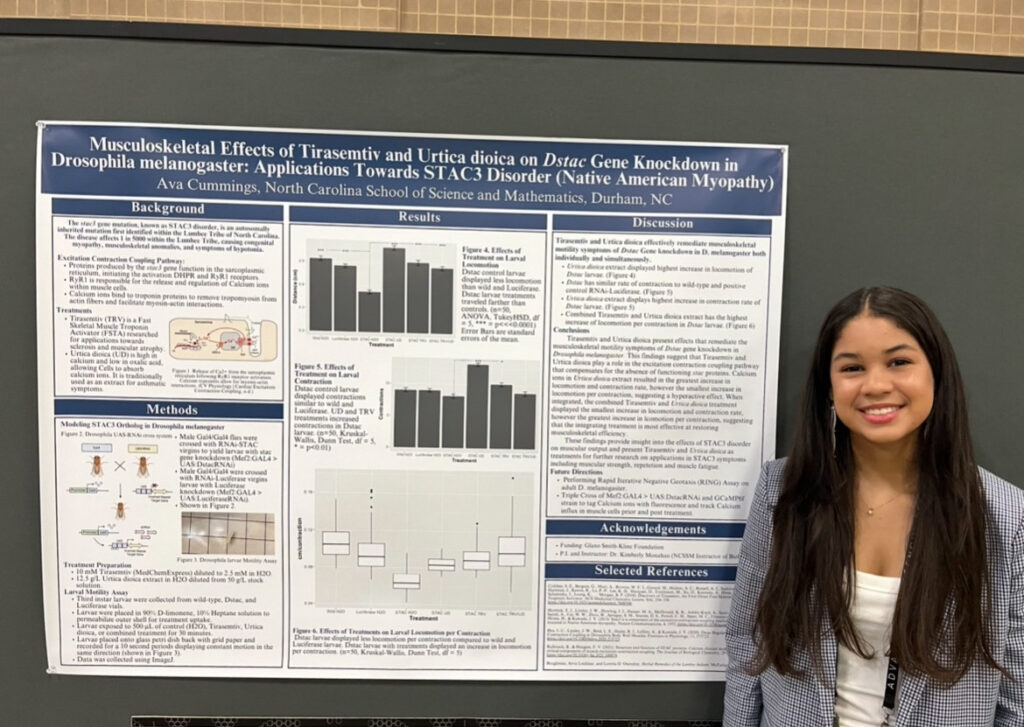
Ava’s research looks into how STAC3 affects both juveniles and adults by modeling the disorder in fruit flies. She’s also investigating how STAC3 might be treated using a drug called Tirasemtiv as well as traditional herbs such as common nettle that are used by her tribe.
“I tested Tirasemtiv and common nettle individually, and then tested them together to see how they would affect people or fruit flies displaying symptoms of the disease,” Ava says. “I found that they were both able to work in some capacity on their own, but then also in certain contexts, they worked better together. So, in a more general, broader context, my research sort of bridges Western medicine and the traditional medicinal practices of my tribe, which I think is pretty cool.”
Ava hopes her participation in the Regeneron Science Talent Search will lead to greater awareness of population-specific diseases. (photo: submitted)
Kimberly Monahan, a biology instructor at NCSSM-Durham, has been mentoring Ava since her junior year in NCSSM’s Research in Biology program.
“I’m incredibly proud of her,” said Monahan. “Working with her has been such an incredible journey. She’s always been very determined, and her passion for this research is incredible. One of the things that makes her stand out is that, as researchers do, she hit some roadblocks, but through her perseverance and hard work, she took her work to another level and was able to elevate her research in a whole different way.”
“I really love Dr. Monahan,” Ava says. “She’s been a great resource through the whole research process, from getting my project idea fleshed out to developing my procedures to running the experiment. Also she just became a really good friend. I still go visit her all the time, and she’s helping me now as I go through the Regeneron process and getting ready for the finalists week.”
That week is fast approaching. Ava and the other finalists will gather in Washington, D.C., March 6-12, where they will compete for more than $1.8 million in awards. She’d love to take home the top prize, but in the end, Ava says, her final placement matters little. “The Regeneron Science Talent Search competition has really given me a chance to put my research out there and expose it to a broader audience, and I’m really excited for the chance to present my project face to face to research professionals, and bring awareness to STAC3 and population-specific diseases in general.”
NCSSM, Ava says, has been a catalyst for her growth as an individual and as a student. “NCSSM played a really big role in showing me that I’m capable of a lot more than I thought I was.”
Like conducting research with a fancy project title full of big scientific words that would have baffled the middle schooler she once was. And when the competition judges in D.C. ask her about her work, she’ll confidently be able to say, “I’m Ava Cummings, and I’m a student at the North Carolina School of Science and Mathematics, and my research is titled “Musculoskeletal Effects of Tirasemtiv and Urtica dioica on Dstac Gene Knockdown in Drosophila melanogaster: Applications Toward STAC3 Disorder (Native American Myopathy).”