A three-plus decade career at NCSSM-Durham placed humanities instructor John Woodmansee among the pantheon of NCSSM’s most revered faculty members. (photo: Brian Faircloth)
news
Longtime humanities instructor named recipient of UNC Board of Governors Award
Longtime humanities instructor named recipient of UNC Board…
Print
Share
The son of a preacher man wanted to be a doctor. But in his junior year of high school, NCSSM-Durham humanities instructor John Woodmansee encountered something that would shape the rest of his life.
Life can happen like that. And sometimes, that twist of fate is regrettable.
But not for Woodmansee. Not in the least. And now, more than three decades after joining the faculty at NCSSM-Durham, that early twist of fate has led to him being named NCSSM’s 2026 recipient of the UNC Board of Governors Award for Excellence in Teaching.
Early ambitions
In the beginning, the Memphis/Marietta/Davidson-raised son of a Presbyterian pastor wanted to be, well, not a preacher. His father may have been saving souls for the hereafter, but Woodmansee had in mind someone else whose work was more immediate. “My aunt was a doctor and I always admired her,” he says, “and I thought to myself, ‘Okay, this is a way to make a good living and, you know, do something useful for the community, and help people with their health.’”
So that became the plan. But something unnoticed was happening behind the scenes. All those hours in Sunday school, and all those sermons his father delivered across three states were sinking in. Not necessarily from a dogma perspective, though there were plenty of respectful and enlightening conversations with his father about religion as Woodmansee grew older. What was quietly settling into Woodmansee’s psyche was the intellectual component of his father’s vocation. In every sermon his father preached, and in every lesson his Sunday school teachers taught, there was a deconstruction of historical memory, oral tradition, theology, and parable in search of meaning.
“That’s what you do,” Woodmansee says of those who study the teachings of their faith. “You read the text, you try and understand its context, you read criticism about the text, and you come up with your own interpretations. That practice has been a part of my life from the very beginning.”
So, too, was the sense of community found in a congregation. Together, these tenets would form part of Woodmansee’s core as he unwittingly moved closer and closer towards an eventual career as a literature instructor.
An awakening
With apologies to his inspirational medical professional aunt, it was Ms. Musgrove – Woodmansee’s junior year high school English teacher in Marietta, Georgia (where his family had moved to serve a local church) who unwittingly disrupted Woodmansee’s plan to go to medical school.
All along he had read on his own, but it never had been something he was passionate about. But under Ms. Musgrove’s guidance, Woodmansee says, Emerson, Thoreau, Whitman, and Dickinson suddenly “opened new realms of thought.”
“That was kind of my intellectual awakening,” he says. “That’s when literature really started to mean something to me on a personal, deep level. I became an inspired reader and writer.”
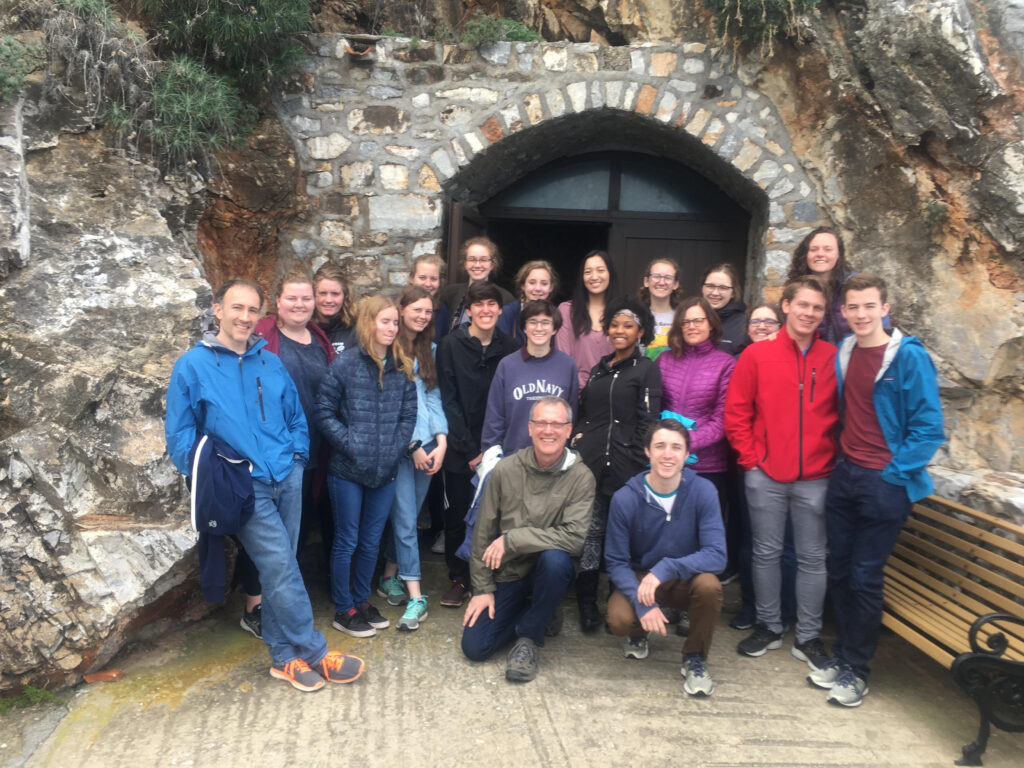
Woodmansee (kneeling, on left) has made 13 trips to Greece as a chaperone with NCSSM students. (photo: submitted)
Never before had Woodmansee sought out literary conversations with friends, many of whom he knew through sports (even today, Woodmansee remains an active athlete, playing basketball on campus each week with fellow members of the NCSSM community). But with an intense budding interest in literature, Woodmansee began to seek out other students like himself. “With my other friends, we mostly just kind of threw a ball around and we really didn’t talk about anything,” he says. “But I really wanted to talk to people about the books,” he said.
So he expanded his friend group the last two years of high school to include classmates who shared his interest in discussing the ideas presented in the texts they were reading.
Ms. Musgrove noticed. She told Woodmansee of a summer program for high school students at a small college in North Carolina that just might be something he would benefit from. It was called Davidson July Experience.
Woodmansee knew Davidson College; he had lived in the town of Davidson from preschool through the middle of third grade while his father had been the campus minister at the college.
Ms. Musgrove wrote a letter of recommendation, and that’s where Woodmansee spent part of his summer between his junior and senior year. When it was over, he knew Davidson was where he wanted to go to college.
Still, the plan remained as before: Woodmansee was going to be a doctor. He took all the pre-med courses in preparation for the MCAT, but he wasn’t a science major of any sort. His major was English.
“I majored in English just for myself, just because I enjoyed it,” Woodmansee says. “I wasn’t thinking that was a career choice. It was just a personal choice because I liked the teachers and I loved to read.”
Give it a shot
Medical school to a career teaching English is something of a leap. Not unheard of, of course, but the paths toward one or the other are not all that similar. So how did someone planning on a career in medicine end up teaching for over 30 years at NCSSM? Mark it all down to a lack of planning.
During his junior year of college, Woodmansee travelled across the Atlantic to Scotland for a study-abroad program at the University of Edinburgh. Along with his literature courses he also took some science courses to help move him toward that medical school goal. But it was the literature that touched him most. Once a week, Woodmansee and three other students would meet as a small group with their professor for an hour and a half to share papers they had written on a topic assigned the week before.
“It was just the handful of us in the room talking about a poem from Chaucer or a chapter from Swift or this novel from Joyce. There was nowhere to hide, but I was doing this because I enjoyed it and wanted to do it.”
Just like with the new group of friends he had made in high school, Woodmansee again had found his small circle.
With all those novels and poems Woodmansee was reading so joyfully, he lost track of his prerequisites for the MCAT. Organic chemistry was the last hurdle to clear once back at Davidson, but he didn’t complete it until the final semester of his senior year.
College had been great, but Woodmansee was now behind schedule. It would take another year to fully prepare and sit for the MCAT. He needed a job. And what kind of job does a brand new graduate with an English degree seek?
“‘I’ll try teaching,’” Woodmansee says he decided. “So I just sent my resume around.”
He landed a job.
Change of plans
At just 21 years old, John Woodmansee, future physician, found himself in front of sophomores and juniors at Porter-Gaud Academy in Charleston, South Carolina, for five classes a day. Add to that schedule three prep periods, a position as the junior varsity soccer coach, and a volunteer advisor role with the yearbook, and what you get is near chaos.
“It’s the hardest job I’ve ever had in my life,” Woodmansee says. “I wasn’t really prepared. I was drinking from the fire hose and working 16 hours a day and I didn’t have time to really enjoy any of it.”
Or prepare for the MCAT. So, Woodmansee decided to delay preparations for the exam, and held on in survival mode till the end of the year.
If “enjoyable” is not really how Woodmansee recalls that first year of teaching, at least he’d found a connection with his students and several of his colleagues. And yes, it was good to be continuing the conversations about literature that had first begun when he was a high school student himself.
The pile of lesson plans he had lost sleep over to create were evidence of how hard Woodmansee had worked that first year. It seemed a shame to just walk away from it all.
“I knew I needed to change some of those plans, but I now had this framework,” he says. “I decided to teach one more year to see if it was going to be fun.”
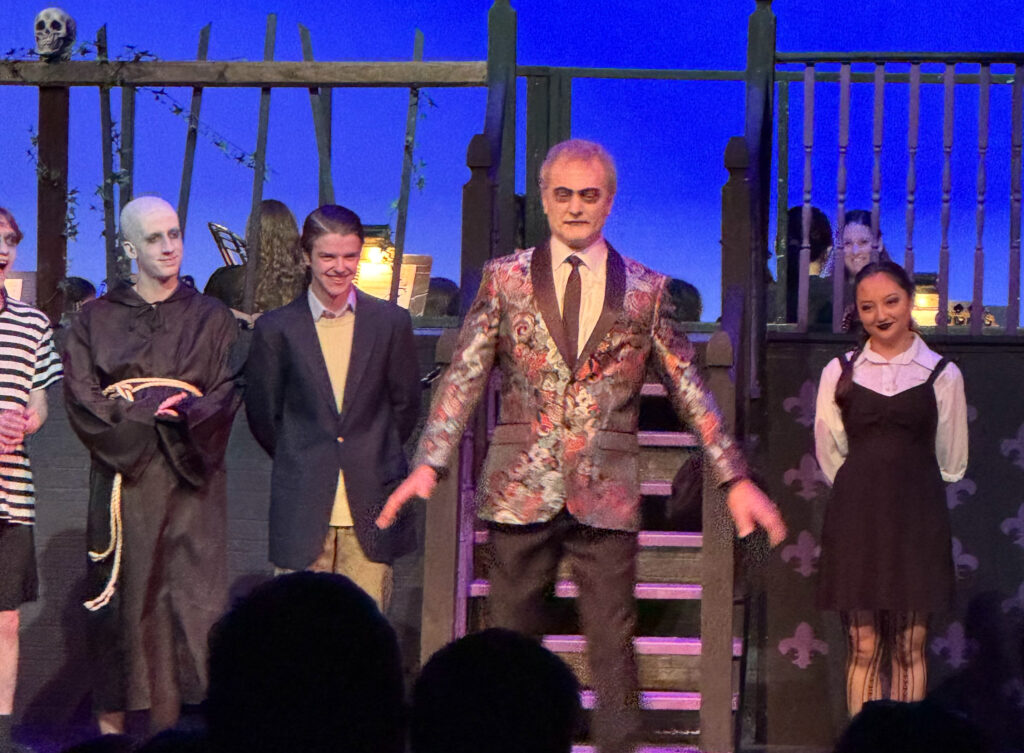
Woodmansee expanded his skill set this past spring when he took a turn as Lurch in NCSSM theatrical production of “The Addams Family” musical. (photo: submitted)
It was. Even though he continued to knock around the idea of medical school through the entirety of that second year, he was enjoying the classroom now. In his students he was starting to see the moments of clarity and recognition that he had experienced himself in the latter half of high school and as a college student.
“I was like, ‘Wow!’ This whole learning process is amazing!’”
The summer after that second year of teaching, Woodmansee made a decision that would, in time, lead him to NCSSM.
“I decided, ‘I’m not going to medical school. I’m going to graduate school in English.’”
Having long wanted to return to North Carolina, Woodmansee enrolled at UNC-Chapel Hill after the completion of his third year teaching in Charleston.
Things evolve
The plan now was to become a university professor. But once again, plans subtly and imperceptibly began to shift.
At UNC, Woodmansee got a part-time assistantship working at a teacher training organization called the North Carolina Mathematics and Science Education Network. He rose through the ranks so that, by the time he graduated with his master’s, he had become a full-time employee, forgoing a PhD program during a lean employment period overflowing with PhDs to run the training program for which he had worked the past few years. Through MSEN he met Dot Doyle and Anita McCoy, two NCSSM teachers who would go on to become luminaries at the school. With him they shared their enthusiasm for the school. Woodmansee was intrigued.
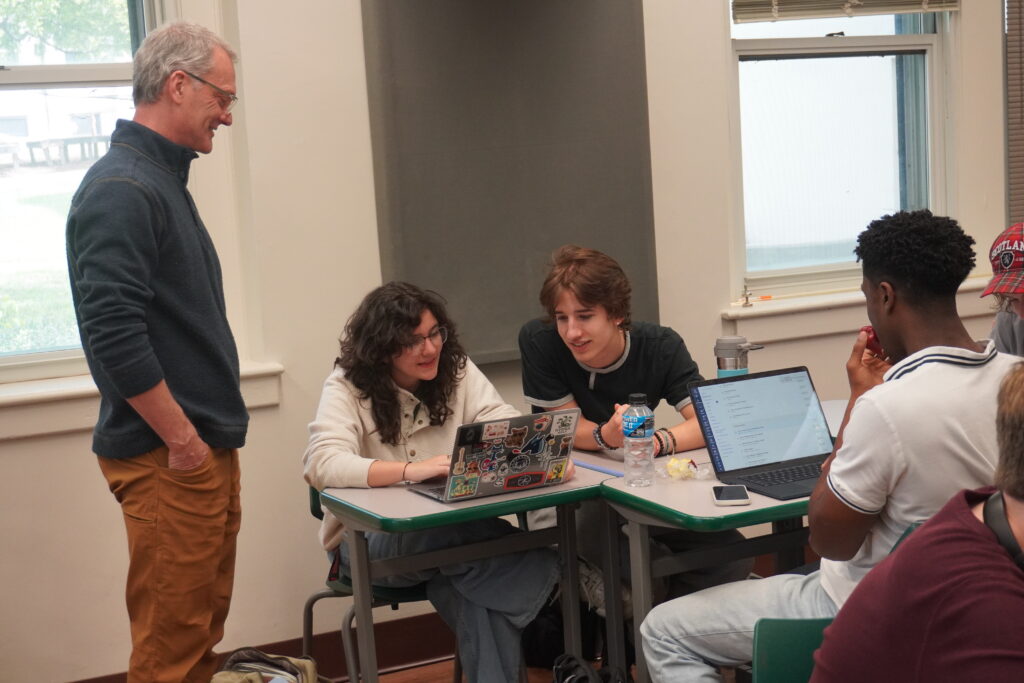
Upon his retirement at the end of the next academic year, Woodmansee will have spent 36 years in NCSSM classrooms. (photo: Leslie Knight)
The work at MSEN was honorable and producing results that enhanced teachers’ skills in classrooms throughout North Carolina. But Woodmansee was on the outside now, wistfully looking in.
“I was sitting behind a desk doing paperwork and talking to people on the phone and sometimes visiting their classrooms,” he says. “But on the way into work each morning I was creating my own lesson plans.”
It was either Doyle or McCoy – some three decades on, Woodmansee doesn’t recall which – that alerted him to a position opening in the English department at NCSSM. It was exactly the kind of place Woodmansee wanted to teach. “It was like a small college,” he says, “but without the publish or perish.”
He applied for the job and got a one-year gig. His first day at NCSSM was two weeks into the academic year. During the hiring process, he’d become familiar with a fellow humanities instructor named Jon Miller. Miller, with his deep, dramatic voice and ready smile, had already assumed legendary status among the students at NCSSM.
Woodmansee landed squarely at the front of a class that Miller typically taught. In a word, it was intimidating.
“I was scrambling, you know, trying to pull everything together,” he says. “I came into a class where they were expecting to get this NCSSM English department icon I’d heard about named Jon Miller, and instead they got me. I was like, ‘Man, I have got to meet these students’ expectations, but I can never be Jon Miller!’”
Challenging as it may have been, Woodmansee had found a home. “I knew this was where I wanted to be,” he says.
Time for something new
The upcoming academic year will be Woodmansee’s 36th – and last – at NCSSM. After that, he will retire and embark on new adventures yet to be defined.
And he was right; he never did become Jon Miller. He became, instead, an NCSSM icon as well whose name and guidance in the classroom will remain for decades deep in the hearts of thousands of alumni.
“I didn’t know that I would stay here until I was 65 years old,” Woodmansee says of his time at NCSSM, “but after that very first year, I knew that this was a wonderful place to teach. These students are curious. They are engaged and they want to talk about what they are reading.”
They are – and remain – just like he was, and remains.
“I may have become the teacher, but I’m still a student,” he says.