
NASA’s Artemis II mission commenced with an early evening launch from Cape Canaveral. (Photo: NASA/Joel Kowsky)


Folks around the world tuned in on April 1 when four astronauts lifted off from Florida on a ribbon of fire as they set out on a 10-day journey to the moon and back. It would be the world’s first crewed journey to the vicinity of the moon in more than 50 years. For students at North Carolina School of Science and Mathematics, the launch was especially meaningful, as one of the four astronauts strapped atop the rockets in an Orion space capsule was Christina Hammock Koch, a 1997 graduate of the school’s Durham campus.
Lillian Anderson, an NCSSM-Morganton junior from Watauga High School in Boone, was on vacation with her family at a North Carolina beach (NCSSM was on Spring Break at the time the mission commenced) when Koch set out on her journey. As the early-evening launch time approached, she and her mother set up in front of the television with plates of food and snacks all around. “A mini launch party,” Lillian calls it.
Ever since she was a child staring into the night sky, Lillian has wanted to float among the stars. Or measurably closer to them, at least.
“I would look up at the stars out my window and I would wonder, ‘What is up there?’” she says. “There are so many mysteries and paradoxes and that’s what fascinates me about space. It just seems like it’s something that I was meant to explore.”
Lillian learned about Koch and her ties to North Carolina and NCSSM from her father, who, like Koch, is also an NCSSM graduate. Lillian did further research on Koch on her own and knew instantly that she had found a role model.
“As a woman it’s important to see people like her because so often we’re not represented in fields like that, and just seeing her be able to excel like that is just really inspiring.”
It was a “surreal” moment, Lillian says, “knowing there was an alumnus of NCSSM on board the rocket as it roared toward space. And it was a special moment, as well, and not just because of the connection between Koch and NCSSM. “I was just sitting there and my mother was letting me go on about the rocket and the people on the mission and just things like that. It was actually a really special moment between us because she always likes hearing me talk about space and things like that.”
Lillian wasn’t the only NCSSM student watching Koch rise into the sky from a coastal area. Ankit Biswas, an NCSSM-Durham senior from Providence High School in Charlotte, did, too. But he got a little closer.
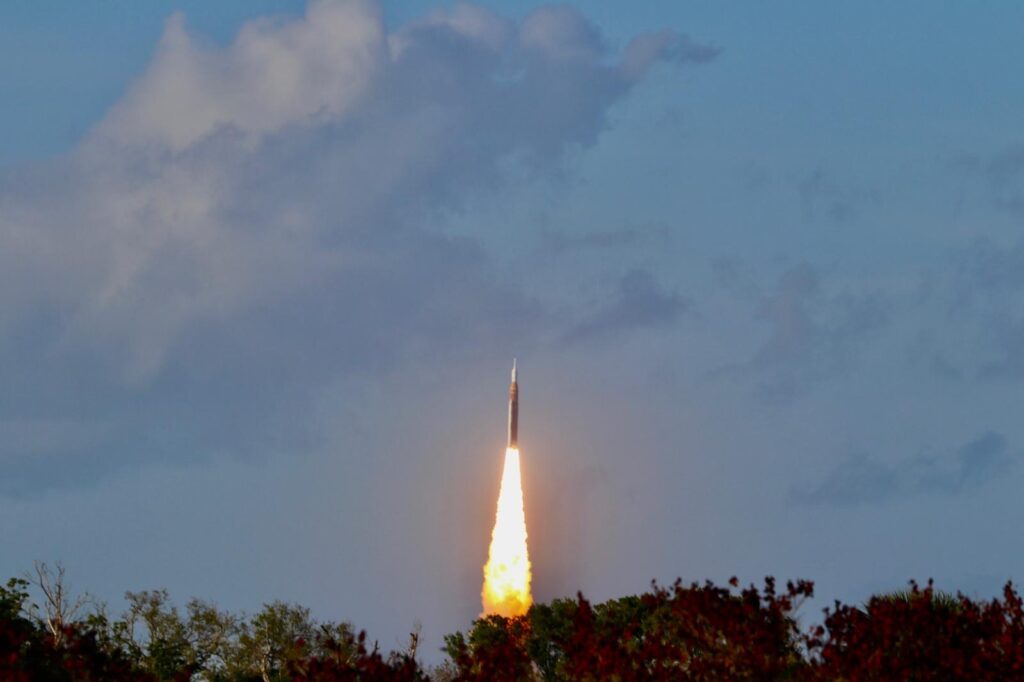
Thanks to the launch coinciding with NCSSM’s Spring Break, Ankit and his parents were able to drive down to Florida to watch the launch atop bleachers set up on the Atlantis North Lawn at the Kennedy Space Center Visitors Center, about seven and a half miles from where Koch and her companions lifted off from Launchpad 39. For Ankit, the trip to the launch area felt like a culmination of all his interests and efforts to study astronomy to this point.
Like Lillian, Ankit’s interest in space began early as well. He found his earliest inspiration in sci-fi books from the local library where he says he was first introduced to space.
True enchantment, however, was found in a book given to him by one of his elementary school teachers. It was called Atlas of the Universe. “I was just entranced by the pictures of galaxies and nebulae,” he says. “I just couldn’t stop looking through it.”
Ankit’s fascination with the universe entrenched itself in him as a ten year old on a dark South Carolina beach late at night while vacationing with his family. Till then, Ankit had spent nearly all his time in a brightly lit city, the night sky hidden by light pollution. But on that dark beach the universe finally began to reveal itself to him.
“I squinted into the sky, and I could make out this faint blur stretching out. And that was really the first time I saw the Milky Way. I don’t think I realized then that I wanted to go into astronomy when I got older, but all of these little things kind of accumulated and motivated my interest in space.”
Ankit and his family took their place near the top of the bleachers at the visitors center at 9 a.m. Nine and a half hours later – at 6:35 p.m. – Artemis II lifted off. The wait was worth it, Ankit says.
Due to the viewing site’s distance from the launchpad, a treeline obscured the rocket on the launchpad, but the anticipation grew as Ankit and the other spectators counted down the final 10 seconds. And then there it was, a flaming man-made machine rising above the treeline as it strained against gravity. “It was massive in the sky,” Ankit says.
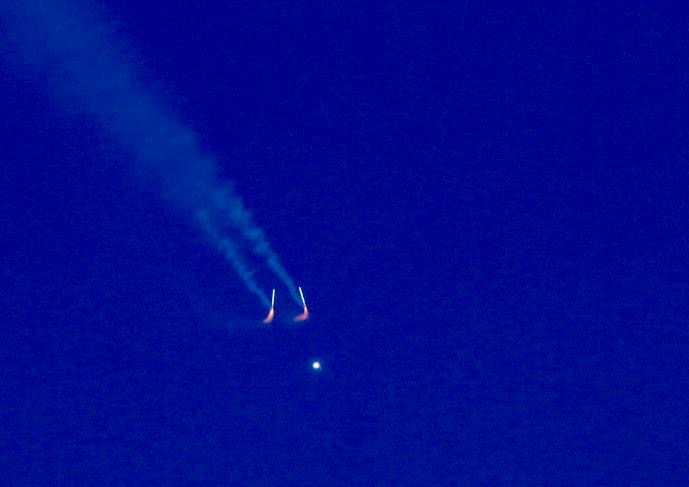
All that fire from the rockets, all those billowing, racing clouds of vapor, and yet there was no sound, Ankit says. Not for a few seconds. And then, “Boom. You could hear and feel this wave of wind hit you. And then when it crossed the supersonic threshold up in the sky, you could also hear like the sonic boom. You could even see the booster rockets separate. It was just so insane.”
Every astronaut who has ever gone into space has been a particular inspiration to students in the schools where they, themselves, once attended. But Jon Bennett, an instructor at NCSSM-Durham and the school’s John Kolena Chair of Physics, thinks Koch’s ties to NCSSM feel particularly special given the school and its students’ focus on STEM fields.
“I don’t know how many of our students want to become astronauts,” Bennett says, “but I’ve known a few who have wanted to. But regardless of the STEM career, students know that we can help launch them with a really good foundation. That’s a big part of why we exist: to help prepare the future STEM workforce. Kids know that about us, and that’s why they want to be here with us.”
Kids like Christina Koch. And Ankit. And Lillian, who has her sights set firmly on one day riding her own rocket into space.
“I feel like every little kid says they want to be an astronaut, but I’m kind of the one that didn’t really grow out of it,” she says. “It’s still kind of one of my biggest goals. Seeing Christina Koch, and knowing that she went to NCSSM, knowing that I’m kind of following in her footsteps, that’s been really inspiring. It makes me feel really hopeful, makes me feel really proud of our state, and of our school, and it makes me want to work even harder to get where I want to go.”
Which is out there, above us all, somewhere between the known and the unexplored.
Christina and the crew of Artemis II will be entering Earth’s atmosphere on April 10 with a planned splashdown off the coast of California.


