
Dr. Helen Moore ’84 will deliver the keynote address for the NCSSM Class of 2026 commencement exercises in Durham and Morganton. (photo: submitted)


Helen Moore ’84 had an unusual ambition in fifth and sixth grade: she wanted to move to the Soviet Union. So deep was her desire that, in preparation, she tried to teach herself to read and speak Russian.
She wasn’t angry at her parents. She wasn’t motivated by more adult matters such as politics or socioeconomics or cultural concerns. Moore’s desire was fueled by something simpler.
“I had heard that if you loved math – and I adored math – that in the Soviet Union you could just do math all the time,” she says.
Moore never made it from her hometown of Charlotte to the USSR, but she did follow her passion for math all the way to NCSSM (where she also began her formal studies of the Russian language) before embarking on a career in academia and the biopharma industry where she uses math to help model diseases and optimize combination drug regimens. She’ll be returning to NCSSM in the latter half of May to share her wisdom with graduates as the keynote commencement speaker at graduation ceremonies in Durham and Morganton.
Patterns and symbols
“I’ve thought for a long time that math is beautiful,” says Moore, who now lives in northern Florida, where she is an Associate Professor at the University of Florida’s College of Medicine. “It’s fun. It makes my brain happy to do math problems.”
One of the earliest mathematical brain teasers Moore remembers is one shown to her by her grandfather, who did a simple trick on a calculator.
“He took one row of numbers and subtracted the reverse, took another row of numbers and subtracted the reverse.” she says. “He was just showing me patterns, but I thought that was incredible.”
Incredible, yes, but as a child math still wasn’t clicking for Moore like it could. Patterns on a calculator were fun, but she struggled very early on. In first grade, she got so far behind that her teacher let her bring a workbook home for extra practice one evening. She sat at the kitchen table and tried to understand. Particularly confusing was assigning the correct symbol to “less than or equal to” and “greater than or equal to” problems. It was easy to decide in her head which number was larger than the other, but interpreting the words for the symbols remained challenging.
“I’d see the words and the symbols and I’d try to figure out how does that fit with which number’s bigger,” she says. “But the words just didn’t make as much sense to me as the numbers. And then my brother said, just put the big part of the inequality on the big number. And I’m like, ‘Oh! That’s so easy, and it’s so fun!’”
Math was finally beginning to make sense. It increasingly became a passion for Moore as she moved through elementary and middle school and the early part of high school. Moore had good teachers and good classes, but the opportunities to advance in her studies simply weren’t available due to a lack of resources.“I really was looking for a challenge and was just so eager for more mathematics,” she says. When the opportunity to apply to NCSSM became available, she didn’t hesitate. “I jumped at that chance,” she says.
Purpose and place
At NCSSM, Moore’s confidence was a little shaky at first, which is common for incoming students. She met students from all over the state who had taken more math courses at their home high schools than she had. It left her feeling “unprepared,” and aware that she had so much to learn. Still, she had secured the thing she had been seeking, and it was much closer to home than the Soviet Union.
“I found my math people, and we just fell in together,” Moore says. “Imagine getting to live with people who love the same things you do, and having breakfast, lunch, and dinner with them, and going to the mall with them, and doing activities with them, and going to math competitions with them. What an incredible experience in those formative years.”
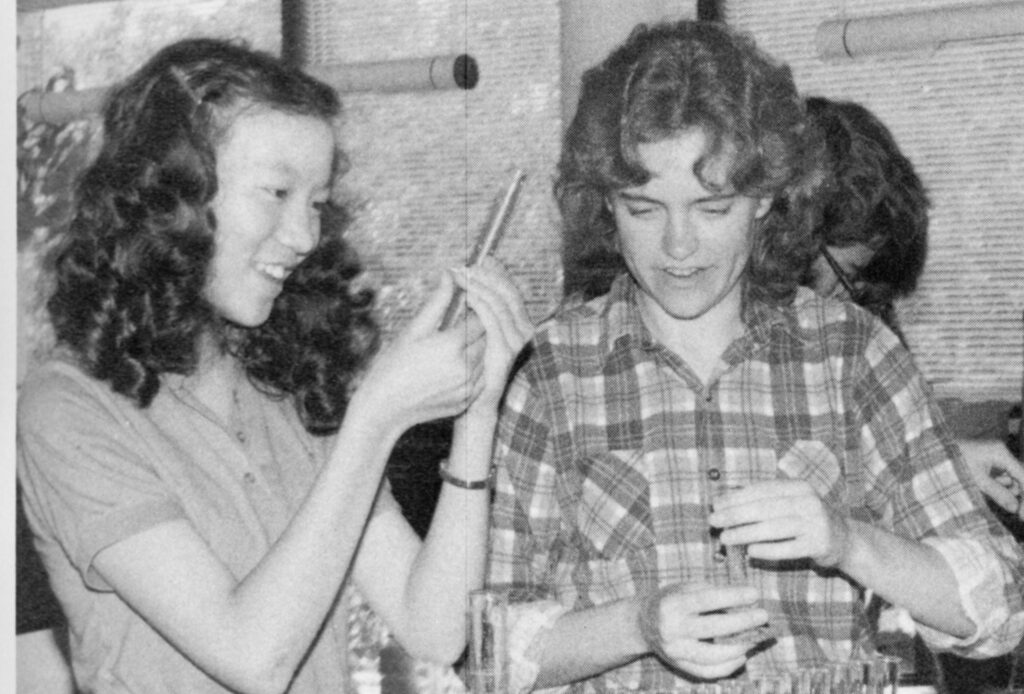
Moore went on to earn a bachelor’s degree in mathematics from the University of North Carolina at Chapel Hill and a doctorate in mathematics from Stony Brook University in New York. After beginning her career in academia, she moved to the biopharma industry for 15 years before returning to academia in 2021.
Her earliest research focused on area-minimizing surfaces, before shifting a few years later to modeling diseases and optimizing combination drug regimens for patients.
Moore’s work in those fields is more than just an academic passion; she is tied to it through personal loss, as well. She entered the biopharma industry in 2006 in part to help people like her Uncle Corky, who passed a year prior from cancer. She endured further loss later when her husband, Colin, passed in 2012. Again, cancer was the cause.
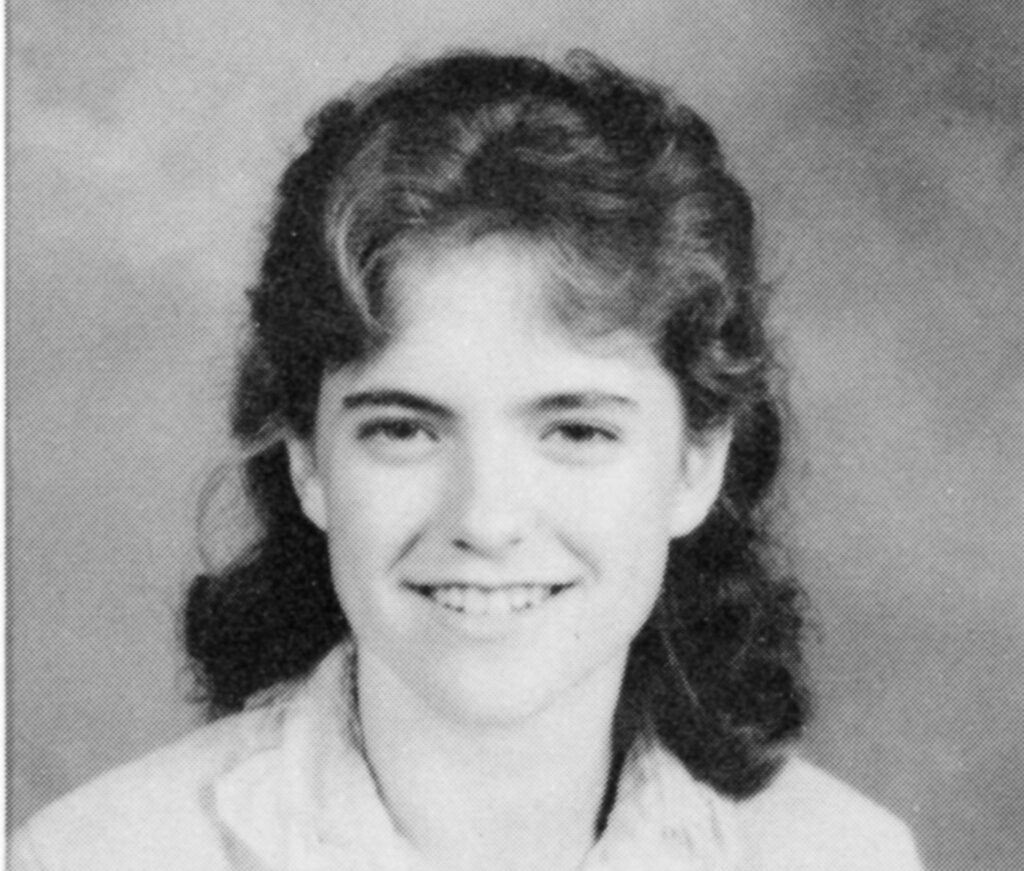
“Math is incredibly beautiful. I kind of stumbled into what I do now, but when I found out that math can be beautiful and help people who are really sick, I was like ‘Sign me up!’” she says. “I really want to help people like my uncle, and my husband. The way my research works, there just wasn’t enough time to help them, especially for Colin, but I am determined to do something for someone else’s uncle, someone else’s Colin, and I know I’m going to do that.”
One way she’s doing that is by inspiring the next generation of researchers and physicians. She is particularly excited to be returning to NCSSM, a place which to this day she holds in the highest regard.
“Those were the best two years of my life so far,” Moore says. “I say ‘so far’ because I’m an optimist. But NCSSM was life-changing for me, as it is for many of us. Those teachers were family, and then of course my classmates – people who are still very dear to me – they’re more family.
“I’m so excited to get to meet the current students and talk to them and see what their dreams and their interests are. I hope that they can identify with me and people like me in all of the fields that they are interested in, and see that they could be doing this, too. They are where I was, and I hope that they’re going to be the ones to continue these important areas of research and have future breakthroughs.”


